

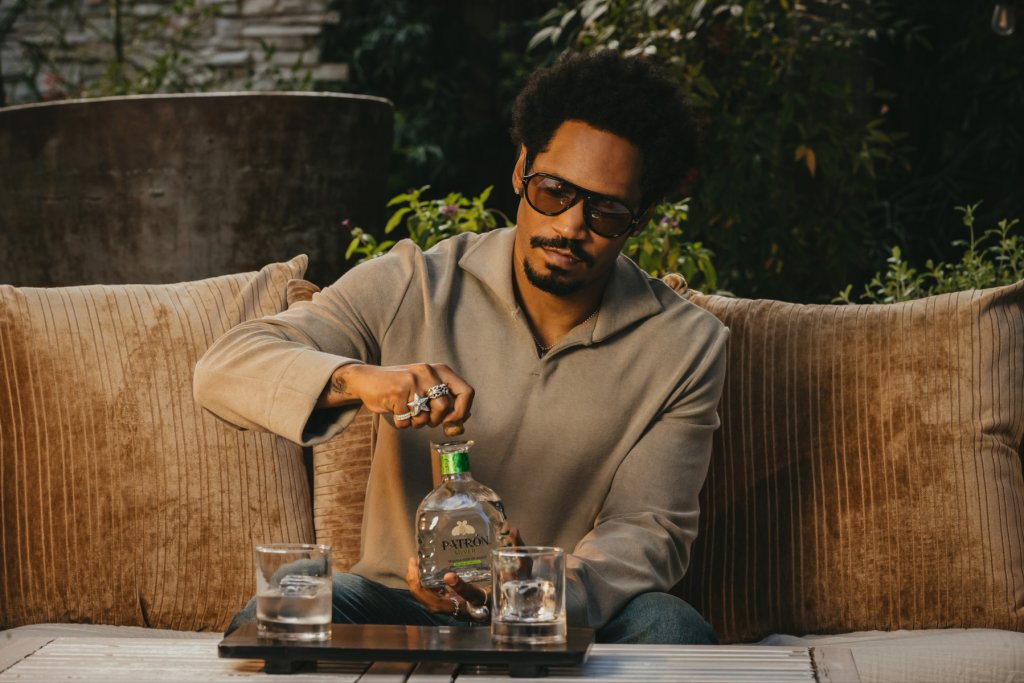

“I’m just catching up on life,” Kaytranada reports over the phone on a recent Wednesday evening in February. “I feel like I’ve been on tour forever.”
After a 2025 run that included upwards of 62 shows, including a co-headlining fall arena tour with Justice, it’s reasonable that the lauded producer has just been relishing downtime in his native Montreal, where he’s spent time hanging out with his family and his new nephew.
But because he’s Kaytranada, one of the more lauded dance/electronic producers of the last decade, even this quiet period has been flecked with glamour. In early February, he celebrated a pair of Grammy nominations (for best remixed recording and best dance/electronic recording for “Space Invader” from his 2025 album Ain’t No Damn Way!) with a party hosted alongside fellow nominee PinkPantheress and sponsored by Patron, the Grammys’ official tequila partner.
While he didn’t win that night, he thinks of the event as a sort of cumulative celebration of his 10 Grammy nominations and two wins going back to 2021. Next year may see him the nominee fields once more, as he’s currently shifting into studio mode with the goal to make another album, a project that, when it eventually exists, will be the fifth solo studio LP in a catalog extending back to his beloved 2016 debut, 99.9%.
In the decade since, Katranada (born Louis Keven Celestin) has become a scene hero for his ability to fuse electronic with hip-hop with R&B and what he endearingly calls “boogie music,” then lace it with a signature swagger and sophistication. Over the phone, he’s warm, funny and enthusiastic, keen to discuss music, touring, tequila and more.
It’s been a few months since you came off the road. What has this time off been like for you?
Basically, I’ve been really ready to work on my next project. I’ve been very eager to continue dropping albums, and I have less of the idea that preparing a big album has to be such a big deal. I want to have an approach where I release more material. Back in the day, a lot of artists dropped albums every year, or even every nine months. I want to approach the idea of an album that way, so I’m working on my next project. I really want to have a deadline so it can maybe come out next year, but we’ll see if that’s even possible, because I literally just got my creative juices going after a month of hanging out.
It’s obviously early days, but is there anything you can say about the direction you want to go in?
I want to come up with a new sound, a new approach to the way I make beats. [I want] to get back to my roots and to how I made music when I was young. It’s kind of like a time machine. I’m going back in the day, to show what I’ve learned to my younger self. It kind of feels that way.
It’s funny because I was listening to your debut album 99.9% recently and wondering if you ever listen to that album, which came out ten years ago, and hear things you’d do differently now.
100%. I would say 99.9% of that album I would do differently. [laughs] I’m not like, looking back and having regrets, it’s just that I would have different approaches in terms of the beats I made. 99.9% was an album I’d been working on for like four years prior to 2016, so a lot of beats were made for other things. A lot of projects morphed into what is 99.9%. I was just over working on that project, and it was 99.9% done, so that was the meaning of the title.
Simultaneously though, that album is considered a new classic. People have mentioned that it’s one of the albums that got them into making dance music. Do you feel the influence of 99% across the scene?
Yeah, I do. This is one of the albums where I was the most free, because it was really no rules. There’s not only dance music on it, there’s a lot of electronic elements. We have BadBadNotGood on the album, and most of the features were hip-hop and R&B artists. I was inspired by MSTRKRFT’s [Fist Of God] album, where the only features they had were R&B and rappers, but they really kept it electronic and did not put any hip-hop elements in the production.
How did you make that approach your own?
My approach was like, “How about I do whatever they’re doing, but in a hip-hop and R&B filter way.” That was the main inspiration of that album, or even of my journey into making electronic music. I don’t think there were a lot of people doing that, so I embraced that fully.
For some reason, I’m the pioneer of what that became… some people call it the Kaytranada sound, which is funny, because I was just inspired by what was going on in electronic scene and fusing it with hip-hop, R&B and boogie music, like disco. That was the influence. For that to be called “the Kaytranada sound” is still funny to me. I don’t know if it’s [my] humbleness or whatever, but it’s not something I fully embrace, because I was inspired by so many things.
Does being told you have a signature sound then make you want to move on to something else and to reinvent, because obviously Ain’t No Damn Way! sounds really different from that first album. Are you constantly trying to push and evolve?
There’s the saying that a lot of the production I make for other artists, people want the classic Kaytranada sound, and I end up doing the classic Kaytranada sound, but it turns into like, “Oh, he’s ending up sounding the same.” So then I was like, “Ain’t no damn way!”
That [new] album is a collection of beats I had stashed, and also some new ones. “Space Invader” was definitely a new production, but half of the album is a lot of instrumentals that have been sitting around since like, the 99.9% and Bubba and Timeless eras. It was a lot of instrumentals that were meant to be on previous projects, and I just tweaked them a bit and made it become a compilation, because part of me wanted to showcase my beats.
Why?
I’m very inspired by beat tapes. Daily I listen to J Dilla beat tapes, Madlib beat tapes, Black Milk beat tapes. Those producers, who are mainly hip-hop producers, are my inspiration. Even the producer Knowledge has dropped a couple house tapes on his Bandcamp, and that was also an inspiration to the project.
You’ve gotten 10 Grammy nominations and two wins since 2021. When you release an album now, is it a given for you that it will get nominated? Is that something you consider during the creation process?
I’m really not trying to think about it while I’m making an album. Every album since Bubba I’ve been nominated… Of course, you get inspired and think like, “Okay, maybe I could win this again.” I am not going to pretend like this has not been an influence during my creation of music.
But I never really thought I was going to even get Grammy nominated. That wasn’t my goal in the beginning. It’s still the craziest thing. I won two Grammys for Bubba, and I think that transcends to like, “Okay, I always took my music seriously, but [this makes it] more serious than ever.” I believed in myself a little bit more when I won. Especially moving to L.A. and seeing things differently than when I was making Bubba in Montreal and just going to L.A. a couple times a year.
How do you see things differently being here in L.A.?
I think it’s my importance. In Montreal, I get that I’m probably one of the most famous musicians, but it depends on what circles you’re in when you go out. When you go to L.A., you’re around your peers. You’re not the most famous person. I feel more comfortable when I go out in Los Angeles, or even when I’m working with somebody else. To me, the humility and the humbleness just shines more when I’m in L.A., and when people show love, it’s more respect in a less freaky way than compared to Montreal.
Then also moving to L.A., it made my profession as a musician more believable. When I was in Montreal, it felt more like fun, a hobby. It felt like street ball, and then for some odd reason I got drafted to the NBA.
You did a big Grammy party this year with PinkPantheress and Patron. How was it?
When you lose a Grammy, you’re not sure if you still want to do the party… But I think people enjoy my parties, so I kept the tradition going. A lot of amazing people showed up. I was shocked with all the people who came. I’m always shook. To have Patron taking care of us as well, it was everything I needed and more.
How much Patron was consumed throughout the evening?
I’m not sure. I make sure I don’t get too f–ked up, but I’ll take a shot to celebrate. I was really celebrating the fact that I was still a 10-time nominee and two-time winner. Even when I put out Ain’t No Damn Way, Patron took care of that and gave me customized bottles. To me, I see Patron at a party and I’m like, “Okay, we’re celebrating for real.” I see the bottle and know it’s going be a good time.
You went on a major co-headlining tour with Justice at the end of 2025. How did that come about?
I’m a huge fan of the Ed Banger label, of [its founder] Busy P, of Justice, so to do that tour was such a big honor. It was inspired by a show we did in Paris [in June 2024] that was more of a party outside during Fête de la Musique. That was an amazing night and an amazing show, and people are still talking about it. That inspired the tour. The agencies were going back and forth, and I got the offer and was like, “Sure, I’ll be down to do it.” It’s was a milestone in my life to tour with them, because they are one of my gods.
What was it like being on the road with them? Did you guys hang out?
I would say we’re both kind of shy, and we don’t talk much, so it was more like humbleness and respect. When we’d cross each other in the hallways, it was always like, “Shake hands, how you doing? Good, good.” and then we move on.
But the Justice crew, they’re party animals. So after every show one of them had this portable DJ [setup] and they did afterparties with the big crew. It was always a party, from what I heard. I did a couple of those and Gaspard was there. He was more around and more partying while I was DJing. That’s where we got bonded a little bit. Xavier is more lowkey. It was really cool, man.
Obviously that tour happened in arenas, which you’ve toured in before and will again in Europe this June. How do you find a way to make venues of that size feel good and comfortable to you?
[For the Justice tour], my team came up with the idea of the floating [stage in the middle of the room], because I’m not really comfortable in arenas. I think that’s too huge. It was definitely compromising for me, because some arenas are not getting the best sound. But we definitely found a common ground to make it cool and not make it just a DJ set in an arena.
And I always try to make it a party as much as possible. I got very inspired also by watching Tiësto back in the early 2000s when he was doing those white parties. He was doing the big stages, big stadiums. There’s not a big difference with that and what I’m doing in terms of how the crowd looks.
You’ve accomplished so much in a relatively short period of time. Do you feel pressure to keep leveling up and topping yourself?
I thought about that for a long time, like “Oh my god, how am I going to do better than before?” But I see the approach as like, this is the game of life. You document what you’ve done for the last few years. When Timeless came out, I didn’t really feel the same love I had for Bubba or 99.9%; it was a different album. I’m very proud of that project, but it was not too electronic; it was definitely more on the R&B side, and there was a constant thinking of “Oh my god, this record did not top Bubba.” But then I was like, “Nah, this is more of a documentation of what I’ve been through.” That’s how I see it.
Say more about that.
I was listening to Prince a lot, going through his albums. In ’86 he was doing Parade, then Under the Cherry Moon, then Lovesexy and the black album that was canceled. This is all literally just a documentation of what he was going through, and people love him for that. I approach albums and music like that. If you don’t like what I’m doing, there’s the old stuff, and it’s all good. If you want to keep following what I’m doing, go right ahead and get along for the journey. That’s all I’ve got to say.