



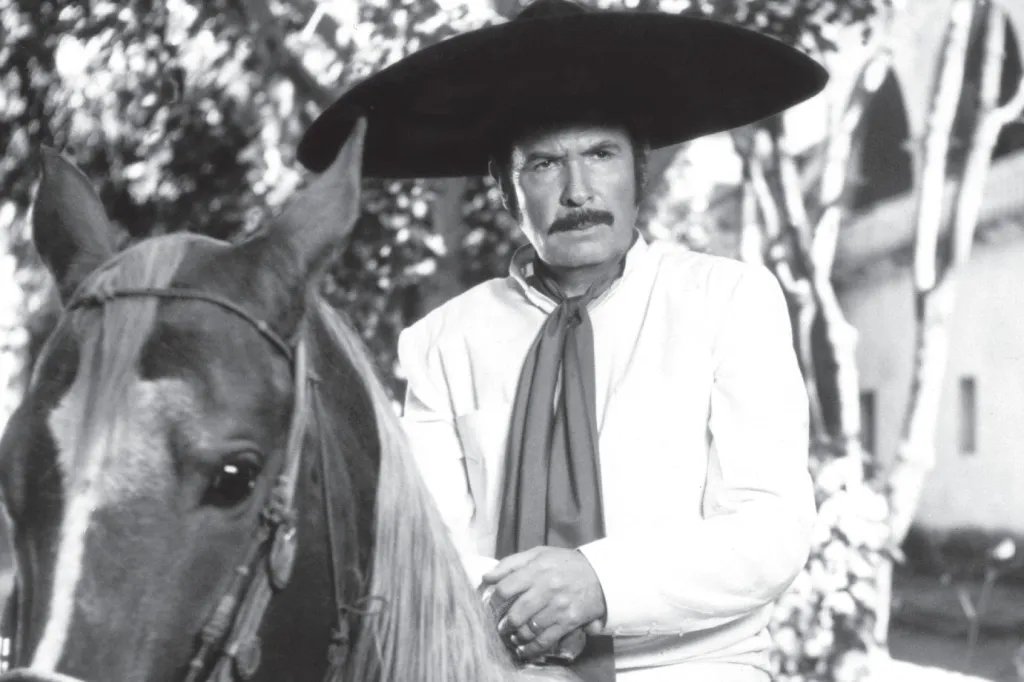

Pepe Aguilar has taken on the task of keeping his father’s legacy alive, this time producing ¡Que Viva Antonio Aguilar!, a compilation album featuring iconic songs by the Mexican music legend reimagined by stars from various generations, from Banda El Recodo and Banda MS to Carín León, Pepe himself and his children.
“It’s a very special album,” he says in an exclusive interview with Billboard Español. “A record like this of Antonio Aguilar has never been done before. We’re showcasing the artist’s interpretation of songs my father once performed.”
In ¡Que Viva Antonio Aguilar! — to be released Thursday (May 28) at 8 pm ET under Equinoccio Records/Virgin Music — Ángela Aguilar and Leonardo Aguilar perform “China de los Ojos Negros” and “El Adolorido,” respectively, while Pepe Aguilar sings “Noches Tenebrosas.”
Among the album’s 14 tracks, Luis R Conríquez lends his voice to “4 Meses,” Banda El Recodo to “La Cama de Piedra,” Chuy Lizárraga to “Ánimas Que No Amanezca” and Banda MS covers “El Chivo.” Carín León takes center stage with the focus track “El Chubasco,” while Edén Muñoz performs “Albur de Amor” and Alfredo Olivas reimagines “El Alazán y el Rosillo.”
Two other women also appear on the tracklist: Lucero with “Triste Recuerdo” and Guadalupe Pineda with “Yo Ya Me Voy de Mi Tierra.” Additionally, a non-Mexican artist, Jessi Uribe, delivers his rendition of “El Hijo Desobediente.”
Also noteworthy is the inclusion of Vicente Fernández — another iconic, now-deceased figure of Mexican music — who shared a friendship with the patriarch of the Aguilar Dynasty and even attended his funeral. On the LP, his voice can be heard on “Ando Que Me Lleva,” in a version previously released on his 2024 posthumous album, Pa’ La Parranda.
“The idea to include Don Vicente Fernández came from my wife,” Aguilar explains. “[My daughter] Ángela participated in the tribute album to Don Vicente, and we thought it would be important to have him on my father’s tribute album since they were very good friends.”
Born in Villanueva, Zacatecas, on May 17, 1919, Antonio Aguilar remains a cultural and musical icon of Mexico, with over 150 recorded albums and hits like “Un Puño de Tierra,” “Caballo Prieto Azabache” and “Lamberto Quintero.” Known as “The Charro of Mexico,” Aguilar was also an undisputed figure of the golden age of Mexican cinema, appearing in over 160 films. A lover of charrería — a traditional Mexican equestrian sport he showcased across the U.S. and Latin America through a equestrian show that has become a family legacy — he passed away on June 19, 2007, at the age of 88.
“I deeply admire my father’s career not only because I’m his son but also because of everything he represented for Mexican music, for how he elevated ranchera music and his unique style of interpreting it, making it a part of our culture,” Aguilar, an icon of the genre in his own right, adds. “He was a proud Mexican who loved his homeland and traditions.”
Below, Aguilar elaborates on the making of ¡Que Viva Antonio Aguilar!
How challenging was the process of creating this album?
We’ve been independent artists for many years, so every album is a challenge. My wife is my partner and helps me along with the great team we have. What I wanted to do with this album was select the songs I most remember hearing in my father’s voice — Antonio Aguilar has many songs that have become part of Mexican culture, so I felt a responsibility to choose carefully what I wanted to present to people. There are representatives from different generations, which makes this compilation even more interesting. The idea is to preserve authentic Mexican music.
As a producer, what challenges did you face with the participating artists?
I had to analyze which songs hadn’t been recorded yet and determine which ones suited whom. My father was a very prolific artist, so there was plenty to choose from. As a producer, I needed to have a song proposal for each artist. I sent them a couple of options, and two or three artists requested specific tracks because they had personal reasons to perform them. Honestly, everyone was very eager and happy to participate.
Was it intentional for each song to bear the artist’s unique stamp?
Absolutely, because these aren’t collaborations; they’re new versions. That was the idea. For example, Edén Muñoz asked me to produce his track, and of course, I said yes. Most artists wanted to interpret the songs in their own style, which I understand because when I’m invited to tribute albums, I end up doing it my way. Poncho Lizárraga also suggested making “La Cama de Piedra” in Banda El Recodo’s signature style, and I was thrilled.
The same goes for Carín León; I sent him the arrangement for “El Chubasco” but he said, “Let me try something crazy.” I told him to go for it. The result is incredible — he even added a touch of tumbado. In my case, with “Noches Tenebrosas,” I remember hearing it on the radio as a child and my dad singing it at his shows. I created a more modern version, and I really liked how it turned out.
Did any artist have a special anecdote about Don Antonio Aguilar?
Actually, they’re all fans of his, but two cases stand out: Chuy Lizárraga has admired my father since he was a child, and it was very important to him to contribute his style to this tribute, which he did beautifully. Similarly, Alfredo Olivas recalls singing a verse from “El Alazán y el Rosillo” differently as a child, and I told him to perform it however he liked because the artists genuinely enjoyed participating in this project. The same goes for Luis R Conríquez.
How important was it to include women on the album?
It’s essential to have female representation. In Lucero’s case, she released a mariachi version of “Tristes Recuerdos” early in her career shortly after my father released it with banda, and it was very successful, so it made perfect sense for her to be part of this project. Ángela created “China de los Ojos Negros” in her unique style, and people love it. As for Guadalupe Pineda, she’s admired and sung my father’s songs from a young age in several films, so she couldn’t be left out.
Why was Jessi Uribe, a Colombian artist, included on the album?
I wanted to include a Colombian artist because my father and Colombia had a beautiful relationship. That country was so important to his career that many of his songs are still sung and played on the radio there — it’s incredible. Yeison Jiménez was initially planned to participate, but it didn’t work out. However, Jessi is a very successful young artist and a fantastic singer. He did an excellent job performing “El Hijo Desobediente” with great admiration.
Some tracks have already been released ahead of the album launch. How has the audience responded?
People have received each song we’ve released so far very warmly, which makes us believe the response to the full album will be even better. It’s incredibly gratifying that almost 20 years after his passing, Don Antonio Aguilar continues to move hearts, make people feel connected to him and inspire new generations to discover traditional Mexican music and great Mexican artists.
Do you feel like the positive response from the audience affirm that the Aguilar family is still seen as significant representatives of Mexican music, despite other news related to your personal lives?
What we do is music, and that’s what we need to keep doing. We focus on that, and this album is proof of it. This year, each of us has many songs to release individually. We do what’s necessary for Mexican music. Each of us has our own message, and we’ll continue to share it in the best way possible. That’s how we respond; the rest is just gossip that’s out of our control.