


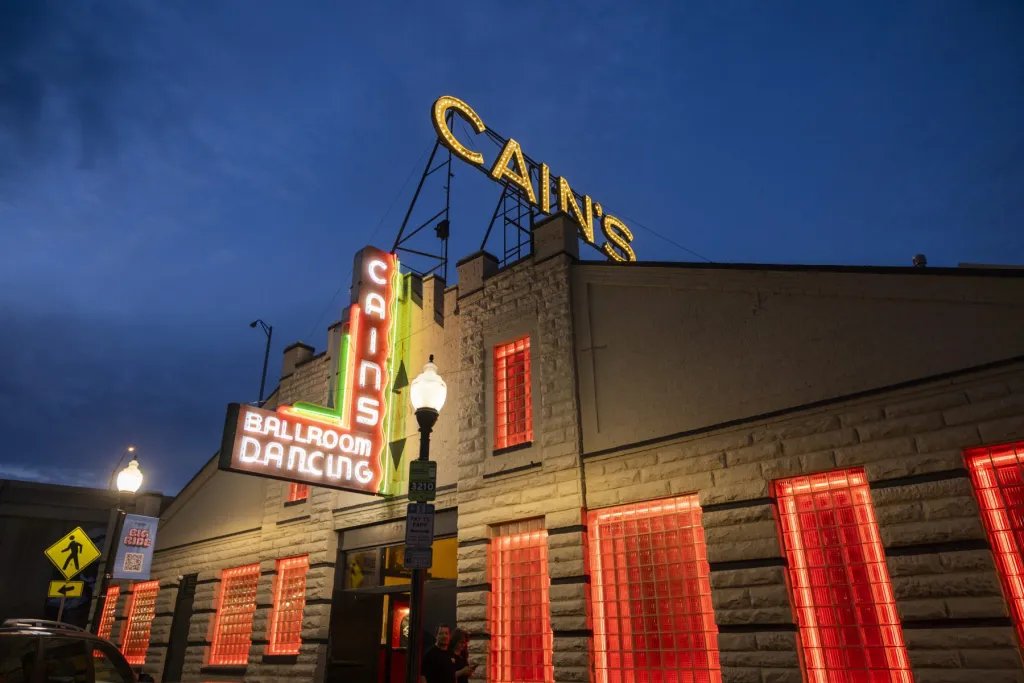

When the Rodgers family began restoring Cain’s Ballroom in Tulsa, Okla. — roughly eight months after purchasing the dilapidated 1924 building and business — they found handfuls of ticket stubs that read “dime-a-dance.” The tickets dated back to when venue founder Madison Cain opened the space as Cain’s Dance Academy in the 1930s, during which men who lived off Tulsa’s booming oil and gas business would spend 10 cents for a dance lesson taught by a man named Howard Turner.
“Turner would hold these dances where he would have women…there to provide dances for men who would buy a 10-cent ticket and come in,” says Chad Rodgers, who currently co-owns Cain’s Ballroom alongside his brother Hunter Rodgers. “Then [he] and the venue would split the proceeds with the women.”
More than 100 years later, the venue still has a painted sign inside advertising dancing at Cain’s on various nights of the week — and it’s not the only relic that remains. The log cabin-patterned dance floor still bounces as it did in the 1930s on what was rumored to be truck springs under the floorboards. The ballroom walls also boast large sepia-toned portraits of folks like Oliver Wheeler “O.W.” Mayo — who managed Bob Wills, known as the founder of Western swing — and Turner, as well as other luminaries who helped make the honky tonk a historic spot off the iconic Route 66. They include Wills and Gene Autry, along with Pat Breene, the queen of Western disc jockeys, and big band leader Spade Cooley, whose life took a dark turn when he was convicted of murdering his second wife in 1961.
“When we took over in 2002, it was like, ‘Should [these portraits] still be there?’ It gives the building and the performance area such a cool historic thing,” says Chad. “A lot of the artists on stage will say it’s so cool to look out there and see all these famous people, or people from the past that have [put] a stamp on either music history or just history.”
For the Rodgers family, their hefty investment in Cain’s was always about preserving its history for the city of Tulsa, not replacing it. In the 1930s, Cain’s became a literal beacon of culture, broadcasting live radio shows hosted by Wills and his brother, Johnny Lee Wills, that “popularized Western swing,” says Julie Watson, Cain’s Centennial coordinator. (Cain’s still flies a banner over the stage that reads, “The Home of Bob Wills.”)
This golden era ended by the 1960s, when Cain’s fell out of popularity. It wasn’t until 1976 that its fortunes began to change: That year, Cain’s was taken over by promoter Larry Shaeffer, who brought such stars as U2, Van Halen, Tom Petty, Metallica, Eric Clapton and Elvis Costello to the venue.
“There’s some good pictures of Van Halen in the Cain’s office when they played here. They weren’t even the headliner,” says Chad. “They were opening for Montrose, and they got paid like $500. I think it was ‘82.”
“Shaeffer was just taking anything he could get,” Hunter Rodgers tells Billboard. “He says it was lucky for him to get these acts. He didn’t really know what he was doing at the time, I don’t think.”
That openness to book even the most chaotic of bands led to Cain’s becoming part of punk rock history. In 1978, the Sex Pistols scheduled a run of nine U.S. tour dates (only ever completing seven), including a Jan. 11 show at Cain’s.
“Sex Pistols [were booked because] Shaeffer got a phone call and they said, ‘We’re gonna route this tour, do you want a date?’ And he was like, ‘Sure,’” Chad says.
After the Pistols finished their rowdy set at Cain’s, an angry Sid Vicious punched a hole in the wall. The piece of drywall with the hole is now framed in the venue’s office.
“The looks of it aren’t great, but it’s the centerpiece of our office. Everyone wants to see it,” says Chad. “I took a picture of Bono putting his fist up to it.”
Despite bringing the venue back to prominence, Shaeffer’s legacy was marred by some of his bad business practices, which reportedly left him broke by the 1990s. “It was a different time then,” says Chad. “We have people all the time that say, ‘I remember when people had cocaine on the tables, and there’d be beer bottles getting smashed and people dancing on the tables.’”
After more than 20 years, Shaeffer sold Cain’s in 1999 to new owners who did not last long. By 2002, Chad and Hunter’s parents, James and Alice Rodgers, saw that the iconic venue was for sale. The next morning, James called his son Chad and said, “Let’s go down and look at Cain’s.” With the revitalization of downtown Tulsa at the time, including an upcoming arena (now the BOK Center), the nearly 80-year-old Cain’s seemed like a good prospect.
“There was dust all over everything. There were chains on the doors. There had never been central heat and air. There were buckets collecting water coming through the roof,” says Chad. “Most people couldn’t have seen through what luckily our father and mother saw.”
James and Alice purchased Cain’s and subsequently handed the keys to Chad and Hunter, the latter of whom was studying audio engineering in Florida at the time. The family knew that if they were going to make Cain’s a legitimate business again, they would have to renovate the venue and its reputation.
“When the news came out that we were going to [restore it], we got a lot of letters,” says Chad. “People were really concerned that we were going to take away from the history and the authenticity of what Cain’s was.”
In May 2003, the Rodgers family temporarily closed Cain’s to work on a full restoration that included the venue’s first-ever fire sprinkler system and air-conditioning unit. They also redid all the electrical and plumbing and put in new bathrooms, replaced the roof, removed the drop-down ceilings, updated the bar and concessions area, and added a small mezzanine. At a certain point, they also had to decide what to do with the “spring-loaded” floors.
“At the end of the life of that old floor, you could stand at the back of the room, and a four-foot person may be able to dunk on a 10-foot basketball hoop,” jokes Chad of the floor, which was springy not because of actual springs but because it hadn’t been properly reinforced. “We were very insistent that when we redid it, that it had to flex. It had to still have the same feel because of that rumor of the spring-loaded was there for so long.”
“Since then, we have replaced it twice,” Hunter says. “Now, it is basically concrete, but it does still flex because there’s some neoprene pads throughout the floor.”
By October 2003, the venue’s initial renovation was complete, allowing Cain’s to open its doors to the community with a show by Dwight Yoakam.
“The Rodgers family, when they bought it, put a lot of money in to renovate it, but they kept all of that feel that makes it completely unique,” says Watson. The family didn’t have much experience running a music venue, however; Chad’s only experience in live music at the time was running a sports bar that occasionally hosted a local band.
“We took our lumps until we renovated and even for a little bit, for about a year afterwards. It took a lot of campaigning getting agents to realize that Cain’s is back,” says Chad. “We also had to patch up some wounds because there was an owner that we bought the business from, and they had burnt a bridge with Willie Nelson and his agent.”
Nelson and his team agreed to return to the venue on the condition that they get a cut of the bar sales. To get more artists through the door, Chad took to cold-calling booking agents.
“I felt like for a long time they were taking advantage of me. It was like, ‘This guy needs shows. He’s going to pay. Just quote him something,’” he says. “Initially, we were blood in the water and sharks just circled us.”
Cain’s was inadvertently making amends for past owners who didn’t handle deals correctly or had gone back on their word. For a time, the Rodgers overpaid for certain acts, spending portions of their own cut to cover everything on the artists’ riders.
“The first time we brought [Bone Thugs N Harmony], I booked 12 [hotel] rooms for them and spent like $1,000 at that time when I really didn’t have to. Then they trashed the rooms, and I had to pay all the damages,” says Chad, who admits the show was still amazing. “I didn’t realize the contract and riders for every artist are pretty much the same, regardless [of whether] they’re playing a 400-cap room or an arena, other than their sound and lighting stuff. I’d get a contract that’s like, ‘We want 16 single rooms and we want a limo or a van and all these things,’ and at that time I didn’t realize that this is [a] negotiation.”
The Rodgers wised up and got a lawyer to help hammer out the details. They also discovered folders of old offer sheets and budgets from previous owners that they used to determine what to spend on advertising and deal breakdowns. Slowly, they began to put Cain’s back on the map.
“I realized that we were doing the right thing when Bob [Dylan] wanted to come play,” says Chad. Dylan took the stage in 2024, and things have “kept flourishing” ever since, he says.
Under the Rodgers family, Cain’s has hosted artists that run the gamut, including Snoop Dogg, Jason Isbell, Chappell Roan, Turnpike Troubadours, Beck, The Strokes, Luke Combs, Chris Stapleton, Lainey Wilson, Blake Shelton, Wilco, Brittany Howard, Mavis Staples, The Descendants, Colter Wall, Flogging Molly, Iron and Wine and Tech N9ne.
Jack White, who first played Cain’s in 2010 with supergroup The Dead Weather, came to love the venue and Tulsa so much that he later purchased property in the city. In 2019, White’s band The Raconteurs became the first act to play Cain’s three nights in a row. Later that year, the band released the live recordings as a special vinyl package. In a press statement announcing the release, White wrote of the venue, “This is my favorite place to play in the world.”
In 2021, Green Day performed a surprise show just days before the band’s stadium concert at the 40,000-capacity Global Life Field. And this past April, GWAR performed and brought the owners a framed poster from when they played Cain’s 30 years ago. Teaming up with the local Woody Guthrie Center and the Bob Dylan Center, the venue has also put on once-in-a-lifetime events, including an acoustic set with Bono and The Edge in 2025, marking the band’s return to the venue for the first time since 1982. “They said the first time they were at Cain’s, only one person in the band was legal age and could get any alcohol. So, this time when they went on stage, they said, ‘Well, now we can get served,’” says Chad.
Since purchasing Cain’s in 2002, the Rodgers family has felt the weight of being the custodians of such a historic venue — yet that remains a driving force for them. Says Chad, “We like the challenge of trying to stay relevant.”