


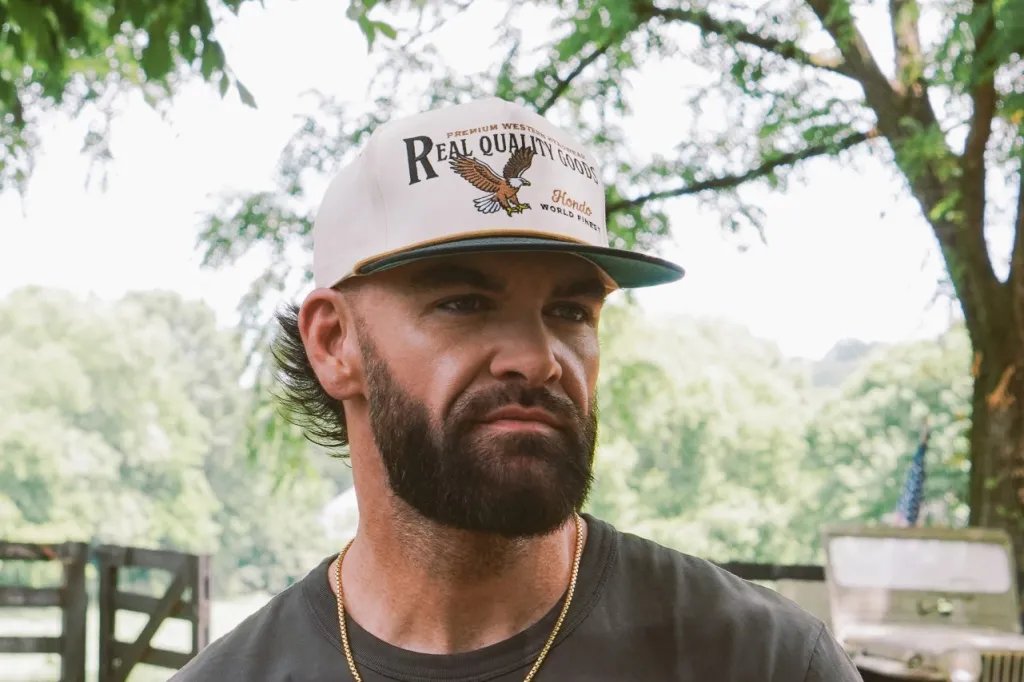

The first time Luke Bryan heard “Dear Big City,” tour mate Dylan Scott was flying with him on a private plane to Austin, Texas.
Listening on headphones, Bryan started whooping it up around the 45-second mark. And when the song ended, emotions took over.
“I said, ‘Dude, are you crying?’” Scott remembers. “He goes, ‘Man, yes.’ He goes, ‘You have no idea. All I could think about was Bo,’ his oldest boy, about to go to college. He said, ‘That [song] is special right there.’”
“Dear Big City,” Scott’s latest single, captures a rite of passage experienced by many young Americans when they start a new life in a different community. It’s a particularly familiar moment for the artists, songwriters and musicians who succeed in Nashville, given that most came from somewhere else. And often from a proverbial dot on a map.
“It’s my story,” Scott notes. “It’s what I did, you know, leaving a little small town, going to the bigger city of Nashville, chasing a dream. It’s what I needed to do.”
“Dear Big City” was built last year, its initial architecture conceived by songwriter Nate Kenyon (“Life With You,” “Dirt Road Dollars”) as he and his wife, Brooke, moved out of downtown Nashville.
They were, he says, “wanting to get some more domesticity in a smaller town, missing my family back home, and so I think that it was maybe from a subconscious place. I was just thinking about small towns, and I’m at that age now where I’m realizing that I gave my small town way less credit than it deserved.”
Kenyon had a first line — “Dear big city, I know you’re busy” — and a concept, and he called frequent co-write Matt Alderman (“Can’t Have Mine,” “Nothing to do Town”) to share it. They worked on it the next day at their regular bi-weekly writing appointment with Jamie Paulin (“Done,” “Happy Does”) at Anthem’s Nashville office.
“Dear Big City” was indeed about relocating, though it took an unusual approach, personifying the small town as it sends a letter to the big city, asking it to look after the kid who’s embarking on an uncertain journey. “It kind of captures the best moment he’ll ever have in that transition,” Paulin suggests. “It’s like the last moment of blind faith.”
With the “Dear big city” greeting as the ideal opening line, Kenyon began finger picking on the guitar and singing whatever came out. Their melodic instincts worked. They wanted the story to match it.
“We really talked about [how] the city’s not bad, Paulin recalls. “I don’t want to bash the city. We came here, we love it here, also we love our hometown, but it’s really about not being able to do what you do, where you want to do it. It was not hard, but a really thoughtful process.”
The small town addresses the city with respect in the opening verse and chorus, hoping the kid can grow without losing his roots. “He needed more than I had to make his dreams all come true,” the small town concedes.
The end of the chorus required some work. They repeated the “Dear Big City” title and simply closed it “small town.” But the message wasn’t entirely clear. Finally, Alderman landed on a winning payoff that retained the song’s hypnotic phrasing: “Dear big city, signed sincerely, small town.”
“The second that he said that, we all just stopped,” Kenyon remembers. “We got chill bumps. We knew that we had something special there.”
The second verse set up the possibility that the kid would come back home to see his college team — they originally made Georgia the draw — and the small town promised to send him back after the visit, his tank filled with “cheaper gas.” That gave the hometown a chance to brag about one of its own strengths.
Following the “Dear big city” opener and the “signed sincerely” chorus ending, a “P.S.” provided the perfect solution for a bridge. That post script referred to BFE — “Bum F**k Egypt” — though they danced around it by promising the kid can return “to B.F. — E-ven if he don’t come back anytime soon.”
“BFE, you know, we try to sing it where the E gets held out a little bit,” Alderman notes. “I hope people get it.”
Alderman produced a demo, and “Dear Big City” got some solid attention. Jelly Roll considered recording it, but let it go. Another artist flirted with it, but Alderman also sent it to Scott, who liked the plot but was underwhelmed by the production. “It was a more hip-hoppy, trappy production that was sent to me, and in my mind, it’s like, this lyric is so deep and so good — it doesn’t need to be quite as fun,” Scott says. “It needs to be a little more heartfelt.”
He let it sit for a couple weeks, but when he came back to it, he envisioned it with a stronger country sound and used Suno to recast it with a darker framework. Another artist had “Dear Big City” on hold, but Scott asked Alderman about it regularly, promising that if he got a shot, he’d do everything possible to make it a single.
Finally, Scott got permission to record it, and he gave the Suno recording to Alderman and co-producer Will Weatherly (Ashley Cooke, Alana Springsteen) to oversee its conversion to the real track. Weatherly whipped together a base for the recording around guitars and programmed drums, then shipped it off to multi-instrumentalist Seth Michael, who built it up further, revising the core guitar with a borderline alt-rock tonality.
“The song is a really sentimental song,” Weatherly observes. “So how do we make it not too soft or too sentimental? You know, how do we keep it to where it also still bangs live? You want the music to sound like the song feels, or like the lyrics feel, because it’s a story.”
After Michael recorded the foundational parts, Scott sang the final vocal at Weatherly’s studio. “Dear Big City” is deceptively rangy, but Scott mostly had it down on the first attempt. “Honestly, that’s probably the take that’s on the record because he nailed it,” Alderman says.
Scott changed a few lyrics to fit him. An off-white ’09 Chevy became an off-white F-150, since he had a Ford deal, and the Georgia sports reference turned into Baton Rouge, even though it had too many syllables to match the original phrasing. They tried some other options, but ultimately the awkward version emerged as the right one. “It’s left-footed,” Weatherly allows. “But I don’t know — something about it. It’s weird, and we missed it, so we were like, ‘Yeah, we should go back to that original phrasing.’ It’s better.”
Nir Z replaced the programmed drums with real ones, and Alderman supplied harmonies for the choruses. Scott fulfilled his promise to make “Dear Big City” a single. Curb released it to country radio via PlayMPE on June 24. It’s at No. 59 on Billboard’s Country Airplay dated July 25, and it reminds Scott of his 2010 decision to move from Bastrop, La., to Nashville to pursue a career. Fans are relating their own stories, and emotions, to “Big City.”
“The notes and the melodies matching up with the lyric just does something that gives me that chill factor,” Scott says. “It has me thinking back on how I grew up, where I grew up, and where I am today.”