

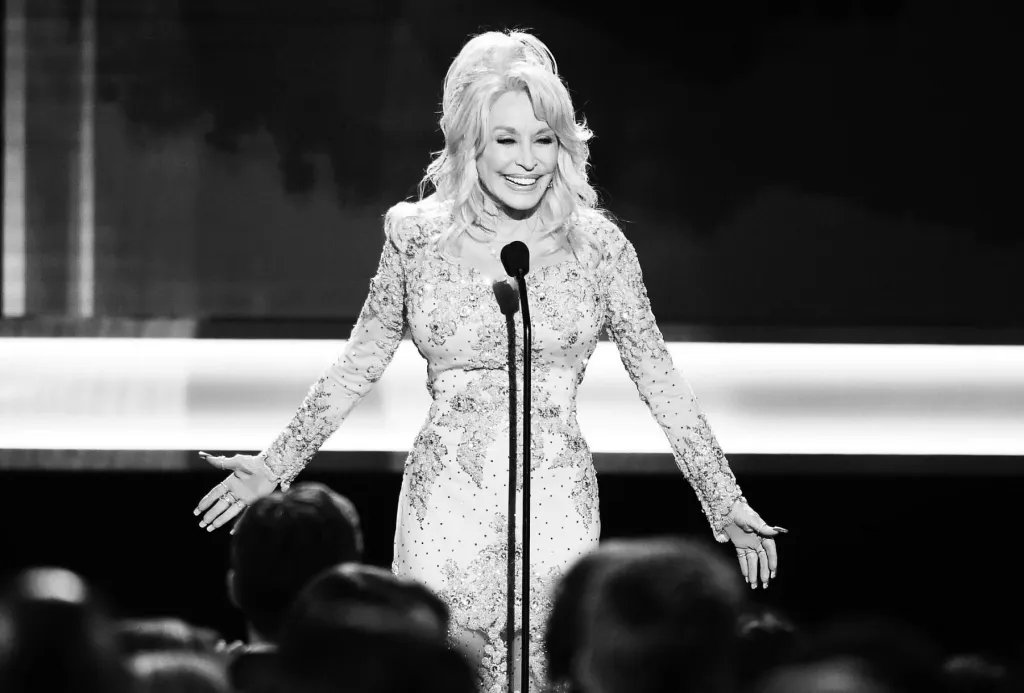

For nearly 60 years, Dolly Parton moved country radio. In the days after her Aug. 25 death, she did it again. As tributes poured in around the world, U.S. radio broke from normal programming, loaded up on Parton’s music and reached across her deep catalog. Some stations even handed over their airwaves to her.
According to Mediabase, encompassing all its U.S.-monitored terrestrial radio stations, Parton’s recordings drew more than 13,300 spins during a seven-day tracking period through Aug. 27, up from about 620 in the comparable previous period, a 2,000%-plus increase. Her music was heard on more than 930 stations, compared with about 135 previously, with 790-plus joining or returning to her catalog.
A Catalog Six Decades Deep
There was plenty to choose from. On reporters to Billboard’s Country Airplay chart, which has tracked the format’s reach since its 1990 launch, Parton logged 28 entries during her lifetime, led by “Rockin’ Years,” with Ricky Van Shelton (1991), and as featured on “When I Get Where I’m Going,” with Brad Paisley (2006), both No. 1s. On the longer-running Hot Country Songs, her history totals 113 titles, dating to her 1967 debut, including 25 No. 1s — the most among women in the list’s history.
In Nashville, iHeartMedia country WSIX threw out its playbook following news of Parton’s death, turning the station over to her music and to tributes from listeners and the local music community.
“Wall-to-wall with the announcement and immediate tribute to Dolly,” iHeartCountry evp Rod Phillips tells Billboard. “We changed the format for Dolly, which turned into 62 songs in a row, plus more throughout the night and [Wednesday].”
Other iHeartCountry stations increased Parton’s on-air footprint to multiple songs per hour, Phillips says. The company also launched a #GoodDeedsForDolly campaign encouraging listeners to perform acts of kindness in her memory.
“After more than 35 years in radio,” Phillips says, “I’m not sure I’ve ever seen a reaction like we are experiencing with Dolly’s passing.”
Beyond the Hits
The tribute went well beyond the most obvious compositions. Across the Country Airplay panel, programmers played 66 different Parton titles in the days since her death, stretching from 1967’s “Dumb Blonde” to 2023’s “Wrecking Ball,” featuring Miley Cyrus (her goddaughter).
Parton’s 1981 smash “9 to 5” — her first of two Billboard Hot 100 No. 1s — led with 799 spins across 135 stations in the week ending Aug. 27, followed closely by two 1974 Hot Country Songs leaders: “Jolene,” with 725 spins on 134 stations, and “I Will Always Love You,” with 665 spins across 133 stations.
But programmers kept digging. At Connoisseur’s KUPL Portland, Ore., music director Jamie Tanchky says that the station initially played Parton twice an hour before moving to hourly airplay. Personalities introduced the songs and talked about their own connections to her.
“We chose to spin a few fan favorites that don’t typically see much airplay on ‘new country’ stations such as ours,” Tanchky tells Billboard, citing “Two Doors Down,” “Why’d You Come in Here Lookin’ Like That,” “Here You Come Again” and “Coat of Many Colors,” while also leaning on “Jolene,” “9 to 5” and “I Will Always Love You.”
Across the panel, 15 titles received one spin from one station each, including “Me and Little Andy,” “Baby I’m Burnin’ ” and “The Lord Is My Shepherd,” a rare departure for a medium known for relatively tight libraries and rotations.
“Dolly was always bigger than country music,” Tanchky continues. “She wasn’t simply a singer and entertainer. She was a true icon with a larger-than-life personality. Her relevance spanned generations and extended into so many different parts of our lives.”
This One’s Personal
That connection was personal for many in the business. Tim Roberts, Audacy vp of country, recalls a backstage meeting that he arranged years ago between Parton and a three-year-old girl with congenital heart disease who idolized her. In a crowded backstage area, Roberts says, Parton spotted the girl and walked immediately to her.
“It was one of the greatest moments I’ve ever seen any artist do for someone,” Roberts says. “It was a beautiful moment from Dolly that truly showed the depth of her character.”
Other Audacy stations responded with an expanded Parton playlist and special programming woven into their syndicated shows. Katie & Company, heard mostly in middays, featured Parton during its Superstar Power Hour, while The Rob & Holly Show, aired largely in evenings, ran a Parton-centric “top seven at 7″ countdown.
At Cumulus Nashville, country WSM-FM afternoon host Tyler Reese went all in on Parton, notes the company’s vp of country, Travis Daily. Stories on the kindness she extended to people from all walks of life took center stage.
“It really was incredible to listen to the outpour,” Daily tells Billboard. “Dolly is one of one and a real loss for the world.”
Bigger Than Country
Parton’s increased airplay was hardly confined to Nashville. WSM-AM and WSIX-FM ranked among stations taking the lead, but stations in Dallas, Knoxville, Tenn., and Austin, Texas, also leaned heavily into her music. Devotion ran deepest across the South and Appalachia, from Charleston, W. Va., to Birmingham and Mobile, Ala., even as her music reached coast to coast, from Portland, Maine, to Anchorage, Alaska.
The response extended to satellite radio, too. SiriusXM launched a dedicated Dolly Parton Tribute Channel (105) built around her music and related artists and collaborators, augmented by listener recollections.
Back on terrestrial radio, Parton’s reach stretched beyond country formats. Her music drew more than 600 spins at adult alternative A stations during the week (up from about 15), while she also received nearly 600 spins at adult contemporary, more than 375 at pop and roughly 375 at classic hits.
Radio remembered Parton the songwriter as warmly as Parton the singer. Whitney Houston’s version of Parton’s “I Will Always Love You” — a then-record 14-week Hot 100 No. 1 in 1992-93 — rose from about 590 spins to more than 730 across all U.S. monitored stations during comparable seven-day periods, a 24% gain. The number of stations playing Houston’s recording grew by around 60 to more than 240.
The response fits the artist. Too big for one format, too big for a single generation.