

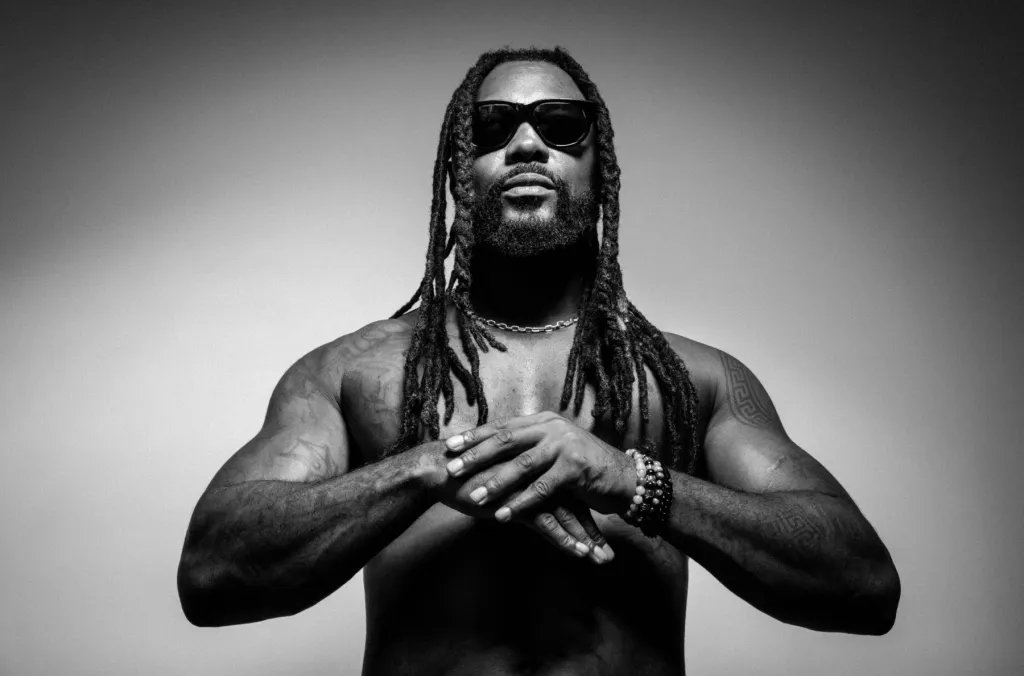

If you can make it in wrestling, what are the chances you can make it in hip-hop? That’s the question AEW superstar Swerve Strickland hopes to answer as he looks to throttle past his newest competitor: the rap game.
For Strickland, his indomitable work ethic helped propel him to becoming the first Black AEW World Champion. After years grinding on the independent circuit, competing across multiple promotions and even landing in WWE, the beloved wrestling stalwart found a home in All Elite Wrestling. There, Strickland has evolved into an in-ring savant, with his hard-hitting battles against Will Ospreay and Hangman Adam Page cementing his place in AEW lore. Now, he’s hoping his bars can cut as deep as his strikes.
With co-signs from venerable MCs like Raekwon and Bun B, Strickland isn’t just chasing five-star matches — he has his sights set on delivering five-mic albums, too. But despite his wrestling pedigree, the former world champion has been adamant about doling out his own lane in hip-hop rather than relying on his accolades inside the squared circle.
“If you listen to my first few records, they had no wrestling in it,” he says inside the NYC Billboard offices last week. “So I had to create from zero, truly. I didn’t use death matches or my world championships. Now, I flex it a little because I’ve gotten more comfortable, but it took my three projects with me, and Monteasy just writing about who we are, to get us to where we are now.”
With an impressive showing on On the Radar and his new collaboration “Coo Coo” alongside Max B, Strickland isn’t opposed to earning his stripes from the ground up, so long as someone is there to hand him the belt and his flowers when the dust settles.
For Entry 023 of Mic Drops and Elbow Drops, Lamarre chats with Strickland about his rap dreams becoming reality, what’s harder between delivering a five-star match and creating a five-mic album, and whether WWE and AEW will ever work together in his lifetime.
What does the recording studio give you internally that the wrestling ring can’t?
Confidence with the vocals. When you’re in the ring, it’s always about your body language. You can’t really do too much with your body language when you’re recording a record. That comes with music videos and performing, but in the ring, the music helped me with cutting promos. I know when to control the crowd, speaking clearly and my pronunciation.
Wrestling requires you to command a crowd, while hip-hop requires you to do that through your words. Which has taught you more about storytelling?
Wrestling taught me from the ground up. There’s Slick Rick’s The Art of Storytelling and Outkast’s Aquemini album with “Da Art of Storytellin’,” but it’s hard to put into a picture. Wrestling helped me hone in on the start, middle and end of storytelling and connecting those dots with why we’re we’re in the ring. It made me ask those questions like, “Why am I doing this? Where is this going?” That was the story.
Then, I started using those same things from a music aspect. If I could make a record about shooting a gun or robbing someone, that’s not me personally. Me as Swerve or Stephon, I’m not doing those things — but if I flip the perspective of who, why and where it’s happening, that’s [the art of storytelling].
Do you feel your star power and credibility in wrestling have helped or hindered your pursuit of being taken seriously as an MC?
I think it’s put me in a challenging position in rap. A lot of times when you hear, “Oh, he’s a wrestler getting into music,” the stigma goes one way — and it’s, “he’s about to rap about wrestling,” when I don’t have wrestling bars at all. That’s what put me in a challenging position. Now I gotta write in a different form. I have to start from absolute scratch.
When you look back at your early journey in both music and wrestling, which was the tougher climb?
Wrestling. It wasn’t until like year nine or year 10 where I got signed to WWE. Year seven was when I got the Lucha Underground deals. That was a decade worth of work to getting on television. That was definitely the longer route and the fact that I did go that [way] before getting into the music actually helped because it’s harder to start from ground up there.
I have a leg up with music because I’m a personality on television now. A lot comes with that. Getting into music was easier because I could afford it and I got to the right people quicker. I didn’t have to go to the homie’s basement or hand out flyers. So I did get the leg up, but the work started from pen to paper, tearing it up and doing it all over again.
You’ve always earned co-signs from New York legends like Raekwon and Max B. What does that mean to you as someone just now breaking through?
Honestly, it’s cool because the first respect I was getting was from New Yorkers like Mickey Factz. That was one of my first co-signs and it was very quiet — which is what I liked most about that. It wasn’t a big shout-out — I was just trying to figure out the craft and somehow get good at it. Then, Jon Connor. I was on records with these guys and they were the ones coaching me and helping me figure out who I was too during the writing process. Monteasy taught me how to rap from the ground up. He was signed to Ruff Ryders at 17. Then, it was Musiq Soulchild, to Raekwon, to Max B to Bun B to Westside Gunn and Benny the Butcher.
We’ve seen a wave of Black fans embracing professional wrestling in recent years. What do you think it’ll take to not only sustain that momentum, but elevate it to another level?
I feel like this is the era of nerdism. You’re seeing a lot of hip-hop culture in anime. New York Comic Con just happened. San Diego Comic Con, I was just there and saw a lot of hip-hop influence. We’re not afraid of saying we watch all the MCU movies or DC. They put it on their jackets and shoes. It’s bleeding over to our culture more, and more, and more. You’re seeing Kanye with the Bully record and putting luchadores in his videos. I met Tyler, The Creator in Atlanta and he said he’s never been to a wrestling show. So we went to a WWE event and saw [Lil] Yachty at [Sunday Night’s Main Event]. Drake pulled up at Elimination Chamber. Travis Scott, Quavo. All of them.
Wale gotta get his first flowers for being there early.
Wale and Westside [Gunn] we’re really the first ones to put their blood, sweat and tears and real money into wrestling. Shout-out to Westside with 4th Rope and continuing to do it. [Shout-out] WaleMania after all these years. Those guys were the forefathers of hip-hop and wrestling culture because they were really in it. I performed at WaleMania.
I won’t say this is the pinnacle of it, but this is very much a peak. I’d definitely say we need to see the wrestlers in the hip-hop world now. There’s always that wall. We’ll let them in, but I don’t see these guys [bringing us] on stage with them or I don’t see these guys on red carpets with them. I don’t see them at Vibe, BET Awards or Billboard. We gotta see them at their own concerts and tours.
John Cena’s You Can’t See Me helped establish a blueprint for wrestlers pursuing music beyond the ring. When future generations look at your career, what do you hope they take away from the path you’ve carved out as both a wrestler and artist?
Not me being a caricature of hip-hop, and not me being a caricature of a Black wrestler. I’m being me. My success in pro-wrestling is genuinely because of my ability in the ring. It’s not because they’re trying to push an agenda, it’s because I perform at a really, really high level — probably the highest level you could see of a Black wrestler in the history of the game.
You have a lot of guys that truly became household names, like the Mark Henrys, Booker Ts, Ron Simmons and Dwayne[ Johnsons] — but you can rarely ever say they were the best wrestler on that show. They had to compete with Eddie Guerrero, Owen Hart, Bret [Hart], Shawn [Michaels]. Great in-ring technical wrestlers. I feel like I compete at the highest level with everybody. Me and Okada. Me and Kenny [Omega]. Me and [Will] Ospreay. Me and Hangman [Adam Page]. The very, very best I hang with every last one of them. That’s why I’ve always approached hip-hop the same way. I have to be pure and genuinely me as possible and get there because of actual ability rather than just co-signs.
Which do you think is harder to do: putting on a five-star match or creating a five-mic album?
Five-mic album. Both parts are subjective, ’cause five mics for one person might be four-and-a-half or four to other people. Five-star match to Wrestling Observer were more like four [star] to anybody else, but to truly grasp the ear of multiple listeners, critics, fans and non-fans is tough. To me, a five-mic album stands the test of time. There’s all-time great lyricists that haven’t been able to pull that off and I’m not even at that level as a pure lyricist. A true genuine classic doesn’t fall out the sky anymore.
You’re the first-ever Black AEW Champion. If you were to win a grammy, which would hold more weight to you?
Wrestling has always been my true love. A grammy is more like, “Oh my God. How is this even possible?” That’s another dream, but that’s what this world title was for me. I’m the only person to come from 205 Live and be a world champion. I’m the only one. If you were ever to ask anyone from the 2017, 2018, 2019 class, and it would have been me out of all those guys? No way. Even me, no way. We don’t see it. A lot of people at that time didn’t see it. Same way in music. Him? Who just did On the Radar? He got some clicks and stuff, but no way.
Do you think they’ll ever be a cross-promotion event in your lifetime between WWE and AEW?
No. Not in my lifetime at least.
Why not?
It’s control. It’s all about marketing. It’s like the NFL, WWE has to protect their shield. There’s no way they’d allow any of our wrestlers to look better and be better [than them]. Obi Femi is a world beater. You gotta protect that and make sure he keeps looking good. Gunther, have to protect that. Roman [Reigns], have to protect that. Cody [Rhodes], have to protect, even more so because of AEW. There’s a lot of that happening.
When it gets to the women, then that’s even tougher. Rhea [Ripley], Liv [Morgan], Chelsea [Green] all have to be protected. You wanna see Seth [Rollins] and Ospreay. That’s the generational thing, but who do you protect? Who has the leverage? Us in the locker room, we just wanna have these matches. I’m good friends with Carmelo [Hayes], Jevon [Evans] and Oba. Those are my boys. I love those guys. I don’t care who wins. Double DQs. I don’t care.
Fantasy booking? Anyone you care to go up against?
I don’t do those anymore. I wanna be the fantasy match. I’m at that stage now.