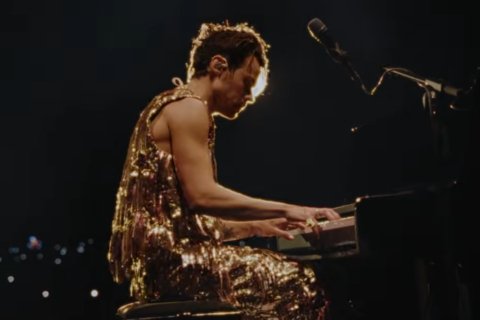


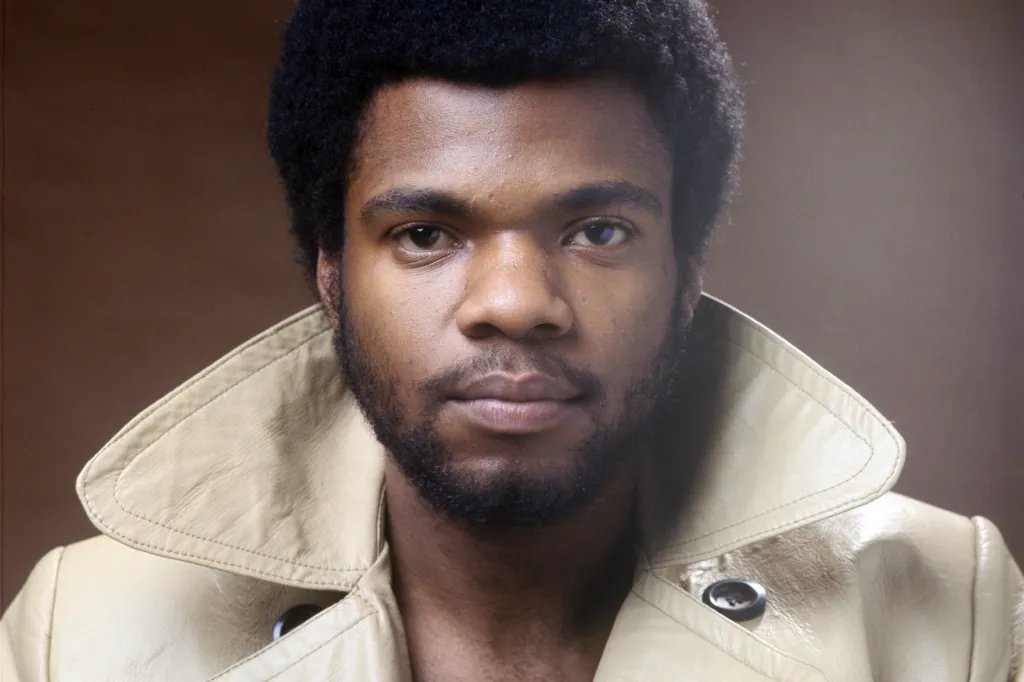

A photo appears in the documentary Billy Preston: That’s the Way God Planned It in which Preston is sitting at an organ across from Barbra Streisand in a recording studio. He’s playing on the Carole King song “Where You Lead” that Streisand covered in 1971 — an accompanying snippet of which soundtracks the photo. Listening to that recording speaks volumes about the gifted, Grammy-winning musician-singer-songwriter.
“You can hear how he pushes her to a funkier extreme,” explains Paris Barclay, the Emmy Award-winning director behind Billy Preston: That’s the Way God Planned It. “When you’re talking about the foundation of popular music, it’s Black music. And Billy shows that incredibly well. Because of his foundation in gospel and the blues tradition of that, he was able to pollinate that around all sorts of pop and rock musicians going all the way through to rap artists who have sampled him.”
“It’s really a testament to Billy’s genius,” adds Stephanie Allain, a producer of the documentary. “He could just slip into any genre and, as Eric Clapton says, be the glue.”
Sparked by a book proposal from David Shaw, That’s the Way God Planned It traces Preston’s life and career trajectory starting from five-year-old gospel prodigy backing Mahalia Jackson to being mentored by Ray Charles and Little Richard. It was on tour at 15 with Little Richard that he met the latter’s young opening act, The Beatles. Thus began Preston’s legendary musical odyssey of performing and recording not only with The Beatles (earning the nickname “Fifth Beatle”) and Streisand but Sly Stone, Aretha Franklin, The Rolling Stones, Clapton, Johnny Cash and Neil Diamond, among many others. In between, Preston crafted a hit career of his own that included No. 1s like “Outa-Space,” “Will It Go Round in Circles” and “Nothing From Nothing.”
Part history lesson and part walk down a star-paved memory lane, Billy Preston: That’s the Way God Planned It — now playing in theaters across North America — is also part cautionary tale. Despite the career highs, Preston also experienced the lows of addiction and several run-ins with the law. In addition, he grappled with secrets tied to his early sexual abuse and sexuality. The latter fostered a tug of war with his faith that he came to terms with before his death in 2006.
During a recent phone interview, Barclay and Allain spoke with Billboard about illuminating a musical genius — and the troubled soul inside.
One comment early in the documentary immediately stands out: “How did we let this boy get away?”
Barclay: When Gloria Jones [a member with Preston of ‘60s gospel group The Cogics] said that, it was a thunderclap for us. It summarized a lot of the people who really love Billy. You can see that love in the film, but also their regret that somehow they missed helping him when he really needed help. So it seemed like sort of a benchmark for the film. It’s our hope that people will look at this film and think about how they can help people they love.
That’s reason enough to have a film like this out there: not just about the glory of Billy Preston, but also the cautionary tale about the next Billy Preston who might be in a similar situation. Like not finding a place in church, even though he loves God. Feeling lost and very lonely — from friends’ accounts — even though he was there with the biggest stars of the era.
Toward the end, there’s another striking comment: “Can you imagine if church was really what it says it is?”
Barclay: Coming from Sandra Crouch as a pastor really says a lot. And that’s a question we bring up. The Black church has always had a huge influence on music. But it’s also had a huge influence on the psyche of many of the people who believe and want to please God with their music and their lives. And there comes this conflict. And so what if the church was embracing and tolerant and did the things that Jesus says we should be doing? That would be something we’d all want to flock to.
Allain: And when Billy Porter says that everybody knows there are queens in the church, that’s something we also don’t talk about. I love that we touch on it in the film because, just like Paris was saying, there are so many people that are affected by this sort of hypocrisy going on.
In chronicling Preston’s life, how did you go about balancing his illustrious career, his faith and the sexual politics?
Allain: We didn’t want to do a hagiography and just talk about all the great things without really understanding him. What we attempted to do was to really get behind his smile a little bit and see what else was going on there. I think his music actually shines brighter because of it, you know. It was definitely a balancing act, though.
Barclay: We approached it through the eyes of love. When you love someone, you see everything: their faults, failings and what makes them lovable. In Billy’s case, it was not only that enormous talent, but his kindness that his smile sort of exemplified. We just really focused on that. We struggled with the balance, trying to figure out how we actually put this together in a way that expresses that love. But I think we found something that seems to work.
What’s your favorite Billy Preston song?
Barclay: I’ll go with “Morning Star,” which is pretty obscure. But you hear it in the movie after his mother dies. It’s really poetic, featuring more of his classical leanings in how he plays the piano. It’s also a love song to his mother. When I hear that song, I also think of my mother, who’s 90, and how she is my morning star, as Billy says in the song. I also think that song extends his legacy of love even further into the new generation.
Allain: I love “I Wrote a Simple Song.” Every time that comes on, I just groove to it. Then there’s “You Are So Beautiful.” And, of course, “That’s the Way God Planned It.” There’s so many, it’s hard to pick.
How did you come to choose that George Harrison-produced song as the documentary’s title?
Allain: We had a lot of different titles, but kept coming back to that one. For a character who’s a little enigmatic, that you can’t really get beyond … it was his statement.
Barclay: It also leaves the audience with the question: Is that the way God planned it? Billy says in the movie that everything he’s done and everything that’s happened to him has been what God has planned. And when you get to the troubles that he’s had, the addiction, you wonder if that’s the way God planned it as well. Or was there something else happening here.
Did you ever feel like Billy was watching while the documentary was being filmed?
Allain: So many of our interviewees said they had dreams about Billy coming to them. Gloria Jones told us that Billy came to her in a solid gold Mercedes. Since she knew him for so long, I asked Gloria if he would approve. And she said absolutely.
Barclay: Manny Kellough [Preston’s drummer] mentioned that before his interview, he had a dream about Billy appearing, nodding to him and then disappearing. And we actually had it in the movie for a minute, although it was one of those things that has to go when you want to tell the story. But we’re feeling touched and blessed by this film.