


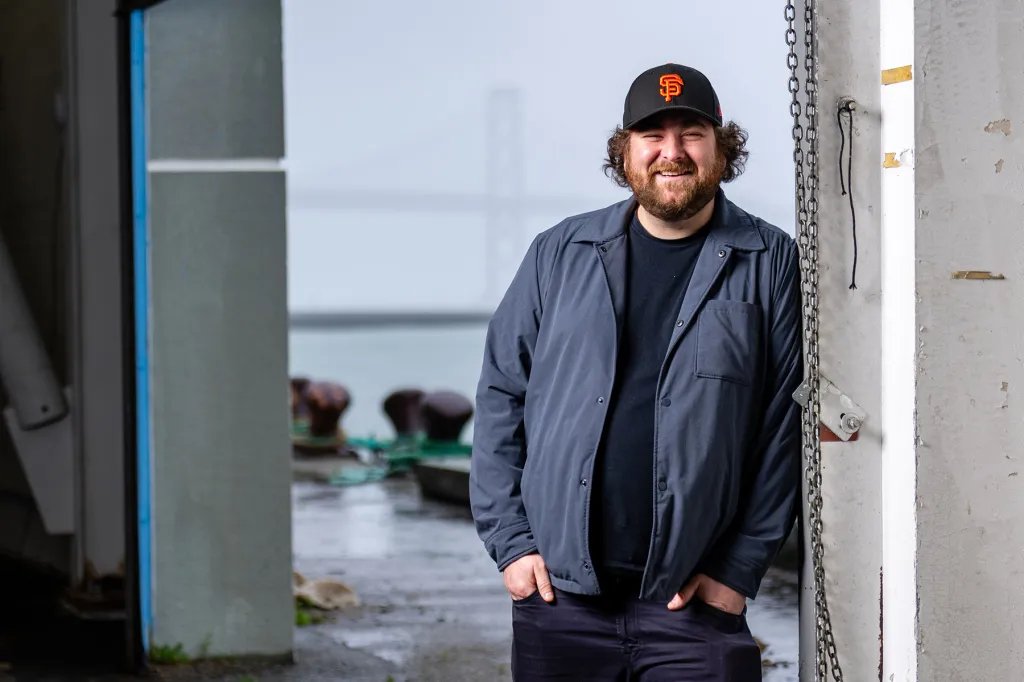

Most dance music fans are used to being up in the middle of the night. So is Danny Bell — but not necessarily because he’s partying.
“Every year after I’m done booking the lineup, I’m like, ‘How the f–k am I going top this?’ ” Bell says of the San Francisco dance festival Portola. “It’s hard. I’m feeling great about the lineup this year, but I lose sleep over it.”
Bell’s anxiety is understandable. Over the last four years, he’s set a high bar with Portola, which he created and leads as senior vp of talent for powerhouse promoter Goldenvoice. Since launching in 2022, Portola has invigorated San Francisco and the broader U.S. dance festival circuit with lineups that present the genre’s pivotal new acts alongside scene legends — in 2025, a murderers’ row that included rave icons The Prodigy, Moby, Underworld and The Chemical Brothers — who younger attendees might be seeing for the first time.
“There wasn’t something in the U.S. that, in my mind, filled this hole of a 21-and-over electronic music event where, in order to go, you’ve graduated from entry-level raving,” Bell says.
Held at Pier 80, a 60-acre shipping site on the San Francisco Bay, Portola leans on its location for mood-setting, letting the 170-foot cargo crane and massive ship docked nearby — which blows its horn once a day during the festival — do the aesthetic heavy lifting. Performances happen across four stages, including one in a 200,000-square-foot warehouse that holds 20,000 people where artists like Fred again.., Peggy Gou, Sara Landry and Chris Lake b2b Armand van Helden have played.
Portola’s creation was an inflection point in dance music’s U.S. evolution when the scene shook off the anxieties of the pandemic and lingering popularity of the EDM sound. The inaugural edition’s lineup presented new acts such as Fred again.., PinkPantheress and SG Lewis alongside modern leaders like Kaytranada, Charli xcx and Jamie xx — all while leaving space for pioneers including The Chemical Brothers and The Avalanches.
For Bell, the lineup reflected a maturation: audiences who’d gotten into dance music during the EDM heyday are now deep enough in the genre to want to see acts who’d paved the way for it. His hunch was correct. The first Portola sold out, welcoming roughly 30,000 people per day. The event has grown in the three years that have followed: Portola now hosts 40,000 attendees daily over its two days and is a key U.S. dance festival that’s also earned attention from fans and industry folks from around the world.
“Portola wasn’t anything where someone said, ‘Do this,’ ” says Bell, who has worked at Goldenvoice since 2016. “This was me going to Goldenvoice and saying, ‘This is a passion project I’ve been working on for six or seven years. This is my dream. Let me do it.’ ”
Bell (right) with Goldenvoice’s Erin Bilbo.
Eric Ananmalay
Like many of the now-adult dance fans he caters to, Bell, 36, got into dance music during the dance boom salad days. Originally from New York, he was studying at the University of Southern California’s Thornton School of Music when he interned at Los Angeles management company Monotone in 2010. The firm, whose roster then and now includes Jack White, Vampire Weekend and LCD Soundsystem, shared an office with HARD, the dance event production company founded by SoCal scene veteran Gary Richards. One day, Bell grabbed lunch for Richards, who subsequently played Bell music by then-rising L.A. beat scene producer The Gaslamp Killer. “He was like, ‘Check these beats,’ ” Bell recalls. “I was like, ‘Yeah, cool dude. This is sick.’ ”
Richards offered Bell a gig running a team responsible for tasks like setting up signage and trash cans at HARD Summer, the company’s flagship L.A. festival, in August 2010. Having recently gotten into dance music through that year’s headliner, Soulwax, Bell gave an enthusiastic “f–k yes” and took the gig alongside three college buddies. (“We got paid in, like, $50 iTunes gift cards,” he recalls.) Not long after, Richards offered him a full-time job. “I was a senior in college and working for Gary full time. I jumped into booking and marketing.” (Given this workload, Bell was two credits short of graduating in May 2011. He made them up in 2015, when USC let him design and teach a course on festivals.)
HARD was thriving in the early 2010s, and its events, which featured some of the era’s most interesting lineups, helped to cement Southern California as a scene Valhalla. For Bell, “the best part was getting to work under James Barton,” the founder of U.K. dance festival Creamfields, who was president of electronic music at Live Nation, which acquired HARD in 2012. “I learned everything from him,” Bell says.
In 2012, Barton brought Bell, then 23, onto the marketing team for Swedish House Mafia’s One Last Tour, an experience Bell says “changed everything for me — mainly because I got to watch [the group’s then-manager] Amy Thomson and her brilliant marketing mind at work.”
That July, the trio headlined U.K. venue Milton Keynes Bowl in a show billed as its last performance ever. At the gig, it debuted its chest-thumper “Don’t You Worry Child,” and then released footage from the set as the song’s video — the last frame of which announced the 52-date, 26-country tour. “They built up this crazy hysteria with a multifaceted global campaign that resulted in the tour’s global sellout,” Bell says. “I watched that all happen and was just like, ‘Oh, so that’s how you market.’ ”
After Bell left HARD in 2016, he took a six-week sabbatical through Europe’s dance music hubs, hitting Paris; London; Berlin; Mykonos, Greece; and Ibiza, where he stopped by island-clubbing institution Amnesia with a plan to check out techno legend Sven Väth for 15 minutes — then emerged from the venue six hours later at 7 a.m., still in his flip-flops.
He returned stateside invigorated by his overseas raving and inspired to create something new for the North American dance scene. He conceptualized what would become Portola — he just needed someone to let him do it.
Bell joined Goldenvoice’s San Francisco team in 2016, helping book and produce the company’s 2021 hip-hop festival Day N Vegas, along with Porter Robinson’s Second Sky festival in the Bay Area in 2019 and 2021. With these events, higher-ups at the company saw, as Bell recalls, that “this guy might actually know what he’s talking about with festivals.” After years of Bell dreaming up the festival — and even having graphic designer friends mock up fake lineup posters for it — Portola got the green light.
“I probably opened a good bottle of wine, smoked a joint and blasted music so loud all my neighbors could hear it and danced alone in my living room,” Bell recalls.
The fully electronic festival joined a Goldenvoice portfolio that includes Southern California juggernauts Coachella and Stagecoach, and company co-founder Paul Tollett taught Bell how to make a festival with a personality and point of view. “Paul really believes in individuality and that the booker needs to be in charge of the vision,” Bell says.
The Portola personality? That goofy friend who’s also a scholar of dance music history. “It’s a very serious event presented in a very unserious way,” Bell says. One viral marketing clip in 2024 featured a rat dancing in the rain to “Unwritten” by Natasha Bedingfield, who was performing that year in the “diva slot” that’s been reserved for pop icons like Nelly Furtado and Christina Aguilera.
Meanwhile, the music comes together through “a lot of long nights and self-torture.” Bell admits that some agents and managers “get annoyed and frustrated with me because I take my time, but I like having conversations and trying to understand everything going on with the artists each year.”
Bell (right) with Club Darc co-founder Marc Gilfry at Pink House, where they started Club Darc in 2010.
Julien Lasseur
“Danny has always been an incredibly supportive partner to artists, and the teams that work alongside them, while keeping the fan experience at the heart of everything he does,” says UTA partner and co-head of global music Samantha Kirby Yoh, who’s booked clients including Soulwax and LCD Soundsystem for Portola. “With Portola and his other ventures, he creates an environment that nurtures curiosity and community.”
Bell’s heavy involvement has helped him forge relationships that serve the festival. “It’s not just that we work with these artists — it’s how we collaborate on production and marketing or come up with creative ideas for additional plays,” he says. “Artists are interested in playing and creating a moment because of the care and the brand we’ve built.”
To wit, when Bell needed a 2024 headliner, he reached out to Australian trio Rüfüs Du Sol, one of the dance world’s biggest draws over the last few years. The group wasn’t touring but the band members, having enjoyed hanging at Portola the year prior as attendees, not only accepted the offer but launched the campaign for their Grammy-nominated 2024 album, Inhale/Exhale, at the festival, debuting new music and a new live show on the main stage. Myriad people in the crowd cried what appeared to be tears of bliss throughout the set.
All this work requires a sprawling team and what Bell calls “a huge allocation of resources.” He puts on the festival alongside Goldenvoice festival director Tim Le and senior director of regional business operations Erin Bilbo. “I come up with the crazy ideas and book the artists,” Bell says, “then she looks at me, smiles, rolls her eyes and pulls it all off.”
The city of San Francisco itself has also been instrumental in Portola’s success. Getting city officials onboard with a festival, especially a dance festival, can often be a challenge cluttered with red tape. “For me, that’s not the hard part,” Bell says. San Francisco Mayor Daniel Lurie has been particularly supportive of the festival since taking office in early 2025, even appearing onstage to talk about revitalizing the city and introducing a performance by Aguilera. (Last year, Lurie also introduced a much different concert across town: One of Dead & Company’s August shows in Golden Gate Park celebrating 60 years of the Grateful Dead.)
“He came into office with a mission of bringing San Francisco back,” Bell says of Lurie’s work in shifting a city beleaguered by a housing crisis, homelessness and drug use. “His whole philosophy is that culture and events are going to be the main driver, and he’s been so supportive.” Lurie and his team have helped navigate new locations and new event ideas, and the mayor even used his official social media channels to announce a Goldenvoice-promoted December show by Fisher at the city’s Moscone Center, in what was the space’s first-ever public musical performance.
“Danny Bell and his team are bringing energy to San Francisco, drawing music fans from around the world and reminding people that our city remains a global destination for arts, culture and music,” Lurie says. “From Portola to major performances at the Moscone Center, Danny’s events are drawing people back downtown, supporting local businesses and revitalizing neighborhoods across San Francisco.”
An aerial view of Portola 2025 at San Francisco’s Pier 80.
Jackson Wigger for Portola Music Festival
With this support, Bell and Goldenvoice are launching the limited-run club night series Club Darc this spring and fall at a warehouse on the city’s Pier 48. The event stemmed from Bell’s realization that of-the-moment house and techno artists including Chris Stussy, Gou and Michael Bibi didn’t really have venues in San Francisco that creatively “piqued their interest.” Club Darc is specifically designed for these acts, who are all playing the 5,800-capacity venue starting in February and March.
“We’re not sitting here like, ‘What’s next?’ ” Bell says of such expansion. “I’m just trying to find cool opportunities and great spaces to produce culture-defining events that are unique looks for these artists.”
Maintaining Portola’s playful ethos, Club Darc takes its name from the college house parties where Bell and his then-roommate, Marc Gilfry of electronic duo Neil Frances, leaned their mattresses on their bedroom walls to make space for dancing, christening these events Club Darc, an amalgamation of “Danny” and “Marc.” The essential goal is still just throwing a quality rager, although the process is now a bit more complex than just moving mattresses.
“We take things seriously, and we really f–king care,” Bell says. “We’re dialing it in all the time, but at the end of the day, it is just music. So how high are the stakes? It’s fine. We’re not curing cancer. We’re just here to have a blast and make sure people have a great time.”
Figuring out the best ways to do that is serious enough to keep him up at night, but the solutions always come, whether its securing a new venue or landing a key legendary artist booking.
“Oh,” Bell says, “I’ve got five more this year that are all A-plus.”
This story appears in the March 7, 2026, issue of Billboard.