

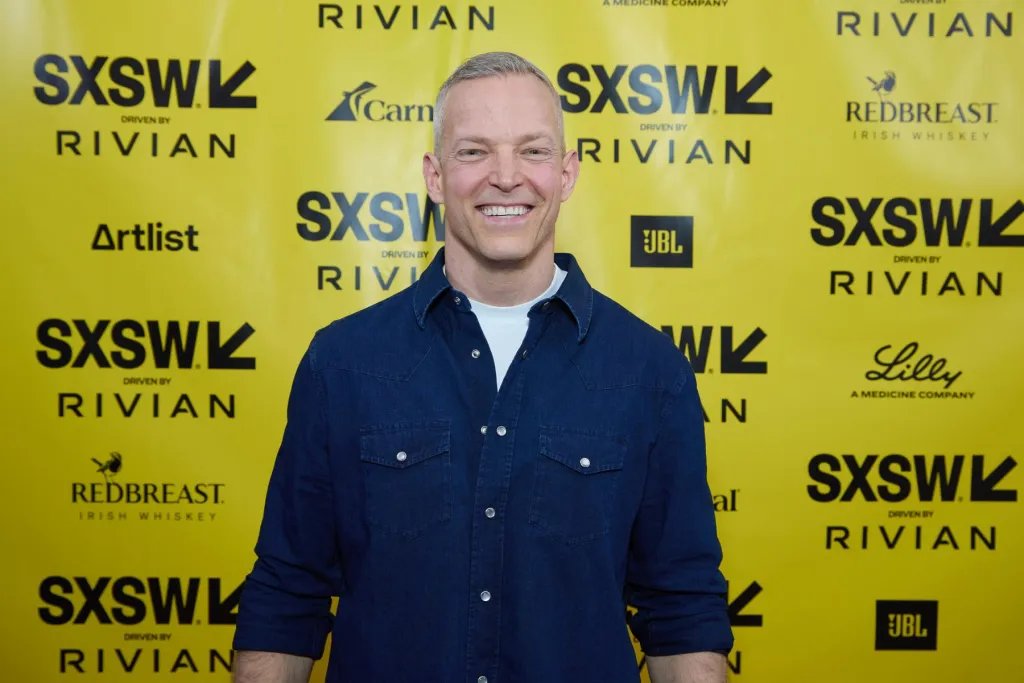

In September, Gustav Söderström and Alex Norström were announced as Spotify’s new co-CEOs, following news that the company’s founder and CEO Daniel Ek would be stepping back and becoming the streamer’s executive chairman, with the new co-leaders taking the reins at the top of 2026. Yet Söderström tells Billboard that, even though he’s only a few months into the new gig, it’s one that he and Norström had been thinking about for a while.
“Almost three years ago, we became co-presidents, and Daniel started handing off more and more responsibilities to us,” Söderström says on a Saturday morning over coffee at Spotify’s SXSW headquarters in Austin. Söderström, previously Spotify’s chief product and technology officer in addition to being co-president, spent the past few years preparing for the extra travel, the increased time interfacing with investors and the greater slate of speaking engagements, like the SXSW keynote speech he delivered to a packed conference room on Friday morning (March 13). And, having watched Ek’s style of leadership for years, Söderström also got to ruminate on how he and Norström might do things differently someday.
“Daniel is a very delegating person — more than any of the other sort of tech CEOs I see, that tend to be very detail-focused themselves,” Söderström explains. “So he started letting us run things three years ago, and we changed the process for how we do things.”
In addition to being more hands-on with consumer-facing initiatives — at SXSW, Söderström rolled out Taste Profile, a new feature (currently in beta, expected to reach premium users in the coming weeks) that allows listeners to command and customize their own algorithms to a greater degree — he also wants to clarify a few things about Spotify. That includes addressing the widespread perception of the company’s artist payouts, as well as how it plans to safeguard against the flood of AI music spilling out onto streaming services.
During a moment of change within both the music industry and Spotify’s C-suite, Söderström wants to explain why he’s feeling so hopeful, with a candor that Ek often shied away from during the years of Spotify’s growth. “People want a positive version of the future,” says Söderström, “and I am 100 percent convinced that we can get that future.” (Ed. note: This conversation has been condensed for clarity.)
Previously you were helping the development of new Spotify products behind the scenes — now, you’re the one onstage, communicating them to everyone.
The responsibility is new. The good thing is, I have this secret love for explaining things. I used to work as a teacher when I was 19, 20 — and I think if I retired [from Spotify], I would probably become a teacher. So it is new, but it’s one of the things I enjoy about the new stuff.
Your SXSW keynote culminated with the unveiling of Taste Profile. Why was the introduction of that feature the pivotal moment?
If you step back, there’s a lot of fear in general around AI. And I think it’s reasonable, because, evolutionarily, the best statistical response to change has been a bit of fear. But it’s very dystopian right now, and I don’t share that — I think there’s a path for a very positive future, and I am 100% convinced that we can get that future. So for me, it’s really important that we share what AI could look like in a positive future, and Taste Profile is a big part of that.
We can talk about generative content, but if we start on the product, I think we’ve been in this rather dystopian future where you sit and scroll through these feeds, and they’re almost scrolling themselves now. It’s just dopamine kicks, and very passive. With generative AI, we realized maybe two years ago that it is an opportunity. If you simplify this, computers finally understand English — now, you can run this 750 million user research group all the time, with a participant of one. We used to do this with 10 people at a time in offices. The promise here is, now you can do it for you, personally. You see this happening if you use ChatGPT or Claude for a while — you can see it actually doing what you want. So why shouldn’t other services do that?
We saw it for a long time, but we haven’t talked about it because I don’t like shipping ideas — I want to ship actual products. Now, I feel like we have enough credible evidence in the products, with AI DJ and now Taste Profile. And I think Taste Profile is a big step, but it’s definitely not the culmination. It is just the beginning, but it’s an important step. People have a very negative connotation of a deep algorithm — so what if we just gave you control over it? We’re going to tell you who we think you are, and then you’re going to be able to say, “I disagree.” And I think that’s a big step in the evolution of technology and algorithms. It was just never possible before, and now it is.
During your keynote, you said the line, “We believe that AI can create a lot of value for artists and the industry, and our job at Spotify is to ensure that the economics reflect that.” Can you give me a glimpse behind the curtain of those discussions about creative and economic concerns? Have creators been receptive, contentious, or somewhere in between?
It is definitely very different across different groups. The podcasters are maybe more opportunity-focused — “Oh, this is going to happen anyway.” That’s not as common in the music space, and not in the author space either, which is maybe even more rigid and, for understandable reasons, very scared of AI. But with music, it’s hard to make generalizations. You have avant-garde musicians who are all the way there [with AI], and then some who say, “Never ever ever.”
As a company, we’ve made the choice to do this the legal and right way, and that has some big consequences. It means we’re slower — if you don’t really care about the rights regime, you can move much faster. I think there are 24 companies now that offer AI-generated music, and they’re faster than us because they take that route. Back with piracy, we were much slower than the competition, but that turned out to be the right long-term bet. This is the bet we’re making again.
I do think AI is an instrument, and it’s going to take some time to understand. But where I think the artist community is right, where I agree, is the belief against just throwing technology out there as if it’s going to sort itself. I don’t think it does. Piracy is a good example — it was peer-to-peer, it created a lot of havoc, users got free music, but artists made no money. Someone needed to actually solve it. That’s what we want to do [with AI]. We want to find the rights machine which works for artists.
You can already create a lot of new music on all of these services, and a lot of artists are using them, [even though] it’s not that popular to talk about. But it’s also a spectrum: you have fully AI-generated music, you can use AI for a choir or a stem or an instrument. Logic has had AI instruments forever. So when someone says, “We shouldn’t have AI music,” what does that mean? I don’t think that’s going to be a very constructive question. Where I think the big opportunities are for artists involves a rights regime to work with existing catalog. If you look at the rest of media industries, existing IP has always been the most valuable — so what we want to try to do is to create a rights regime where artists who want to can voluntarily participate and say, “I would like people to be able to play with my music, if I get paid for it.”
We already know exactly who did what on every song — we know the composer, we know the performer, we know the producer. It’s a rights problem, so that’s what we’re focused on solving. And my hope is not if we solve this, but when.
You touched on fully AI-generated tracks, which is the more dystopian end of the AI music conversation. Some studies suggest that thousands of these tracks are flooding various streaming services each day. I’m curious how focused you are on that, and if you’re considering putting in new guardrails for those tracks.
There’s a lot of nuance here. There is some great new music being made that’s actually innovative: in Sweden, this band Jacub used something like 600 prompts to create this song that was on the charts, which is interesting in itself. But then with all these technologies, fraud, impersonation and mass copying also gets easier. So I absolutely want to acknowledge that, but from our point of view, that didn’t start now — there’s always been a lot of people trying to game our system. So we voluntarily invested a lot in fraud detection all along. It’s actually not a new problem — it’s just much more of the same problem.
We announced that, last year, we took down 75 million spammy tracks, and I want to say that’s more than anyone else is doing. We have a big team focused on fraud, stream manipulation and paid streaming. And certainly, impersonation has happened before, but it’s just getting way easier. There is no ambiguity in the law — you’re not allowed to impersonate someone. So for us as a technology company, it’s an opportunity for us to to be, frankly, the best in the business of detecting these things. So far, I think we do a good job.
What’s been the response to your annual Loud & Clear report? Are readers surprised by the numbers?
Yeah, which makes me a little bit sad, because it means we’ve done a bad job communicating. There is one thing I really regret about Spotify, which is that, pretty early on, people started talking about per-stream payouts, and how Spotify pays less. And the general advice at the time in terms of communications was, “Don’t engage, because you’re going to amplify. Things die down, and if we just keep paying more than anyone else, the record is going to set itself straight.” It did not. This is my big learning — you have to go out and combat narratives, because if you just let them be there, they become truth. When we do go out with this information, people are like, “That doesn’t fit with what I heard. I heard that you pay less than everyone else. There must be something wrong here.”
We’ve paid out $70 billion so far, and $11 billion just in the last year. It’s been 10% year-on-year growth, and these are enormous numbers. So the point I was trying to make was, the music industry is bigger than it’s ever been, no one has ever paid anyone this much money in the history of music, and people still talk about that the heyday of the ‘80s and the CD era. People will say, “If the pie is bigger than 1774011981, then Spotify must be taking a bigger share.” No — we all pay out about 70 percent. Then people will say, “Well, maybe it’s bigger, but there are so many more artists now, it’s less [revenue] per artist.” That’s a good point — the amount of artists has grown tremendously, which is not something I’m sad about. But even this is not entirely true. This year, almost 14,000 creators made over $100,000 — and not only is that 1,500 more than last year, but it’s actually more than the number of people who made $50,000 12 years ago.
So on every metric, we are paying out more and more, but the thing I really regret there is that we let the per-stream discussion take root. The record that I’m trying to set straight now, instead of hoping that it gets set straight, is that no one actually pays per stream. We all pay per user, and we all pay roughly the same — to simplify, about 70 percent, [for] Apple, Amazon, YouTube, Spotify. But Spotify has three to four times the engagement per user than other services, and that means, if you take the same 70 cents but divide it by four, you’re going to get a lower per-stream count. And so the solution cannot be to make Spotify three to four times worse, because then we just turn into another service that has lower engagement.
And I think, for the music industry, the number one metric they should focus on should be user retention. If you’re a subscription [business], retention is everything, and retention is very closely coupled to engagement. So to push people over to the lower-engaged services is bad for everyone. In a very weird way, the lower per-stream is good, because it means that people are using the services more, which means retention goes up, which means revenues goes up. This is sometimes a very complicated argument to make on Twitter, but yeah, I want to set the record straight: the per-stream is an outcome, and we actually pay per user. That’s what I wished I would have said many, many years ago.
Moving forward, how do you address the dissonance between what you just explained and the perception that Spotify pays less to artists? Is it more interviews like this? Is it more artist testimonials, which made up a big part of Loud & Clear this year?
It’s both us being much more clear, and then also getting the artists that want to speak about this to do so. And it’s very helpful, obviously, if artists say it themselves, rather than Spotify saying so. And I’m actually very proud of what we’ve done for the music industry, but the message I want to send to artists is that it’s very important to understand how it’s working, and get the truth there about [the size] of the pie. Artists and creators should be quite excited, because I think the entire music industry says, “This is the pie, now let’s try to fight over it and slice it,” but the pie has grown tremendously since we started. There is no good reason why we’re at the end now.
Spotify has been scaling up its live music offerings, both in terms of events and ticketing. What do the next few years look like in that realm?
Our core strategy is to help artists, and touring is enormously important for many artists. We already give artists information about where their listeners are, who they are demographically, which tracks they listen to. But a couple of years ago, we started also just selling tickets for them, from all the providers, as an aggregator. And the reason we could do this is because we know who the biggest fans are.
The scalping problem is enormous. Artists are so upset when their biggest fans get pushed out of the queue for someone buying all these tickets. We’re really well-positioned to solve that, so we simply started selling tickets for them, because we can show it to the right people so they actually get a chance to buy these tickets first. I think we’ve sold about $1.5 billion dollars worth of tickets, and I think we’re gonna keep growing that. We’re not making a lot of money from that — we’re just helping artists, and we’re helping the revenue. I want the revenue statement to be, “Spotify made this much in streaming for me, and they sold this many tickets for me.” We want to be this full solution for artists.
Spotify is celebrating its 20th year, and you’ve said that you want to be with the company for 20 more years; meanwhile, other companies want to position themselves as the Spotify of the next era, the AI music era. How do you stay on the cutting edge of innovation as a major, veteran company?
People say you should follow the money, but I think that’s wrong. People say you shouldn’t follow the revenues, you should follow the margins, but Spotify was unprofitable for years, while most other people in the value chain were profitable. We just invested and invested, and we keep investing a lot back into the company. That is the only way to stay on top.
The way we think about the moment we’re in now, it’s very analogous to either the original piracy moment or the smartphone moment. It’s a time of tremendous change, but that is the time that companies grow. Google and Amazon got bigger through each of these changes, and so did Spotify. Now with AI, it’s the same thing, and Alex and I look at this time as an opportunity to do more, not less. When there’s a lot of change, it is much easier to do new things than when the market is very stable, and everyone has their position.
The simple answer is, you need ambition as a company. And Alex and I named this year “the year of increased ambition,” to clarify to the company and to our employees that we are raising our ambition. The reason we stayed around working for Daniel for almost 20 years is because his ambition always kept increasing. We’re trying to be public about that, and we’re trying to show it by the amount of money we invest back in the business, instead of trying to extract value and maximize margins. I think we have a good chance. You’re just gonna have to take some risk, but risk-reward is a real thing.