



It’s a sunny afternoon in late July, and it’s been a particularly good day for Capitol Music Group (CMG) chairman/CEO Tom March: Already, Paul McCartney received his first-ever Mercury Prize nomination; Capitol Christian Music Group (CCMG) garnered 112 Gospel Music Association (GMA) Dove Award nominations, its most in at least a decade; and two of the label’s brightest stars, Doechii and Leon Thomas, landed on Michelle and Barack Obama’s annual summer playlist.
But there’s plenty more good news for the 45-year-old March, who took over the top spot in February 2024. British singer-songwriter Sienna Spiro’s career is skyrocketing, with her debut album, Visitor, coming in at No. 9 on the Billboard 200 in July and breakout single “Die on This Hill” reaching No. 19 on the Billboard Hot 100. Sam Fender, whom March signed when he was co-president at Polydor in the United Kingdom, is sitting atop the U.K. Official Singles Chart with his Olivia Dean duet, “Rein Me In,” which broke the record for most weeks at No. 1 on that list, now at 21. Meanwhile, each of rapper Yeat’s last three albums have debuted in the top five on the Billboard 200; new artists like British rapper EsDeeKid and Slovak singer-songwriter Adéla are breaking through; rockers Yungblud and Royel Otis continue to gain audiences; and superstars like Katy Perry are having streaming resurgences.
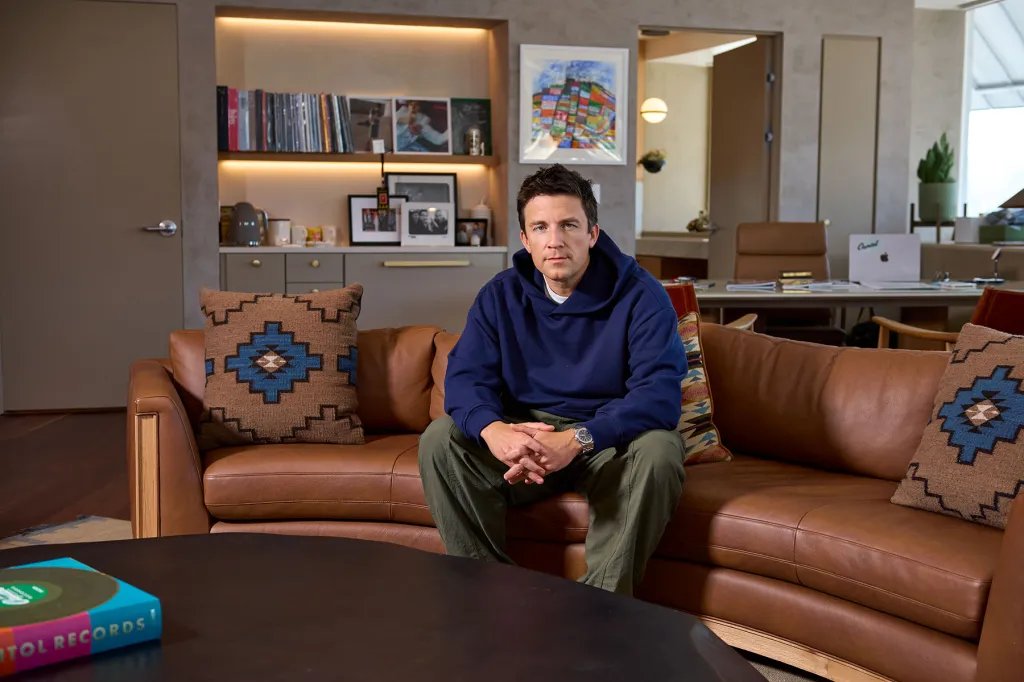
The British-born March, a self- proclaimed “ ’90s indie boy,” is taking it all in with a cup of tea as sunlight streams into his spacious office in Hollywood’s Capitol Tower, which reopened in December following more than three years of renovations. March became U.S. president of Geffen Records in 2022, following 16 years with Universal Music Group (UMG) in the United Kingdom, where his roles included co-president of Polydor for six years, as well as GM of Virgin Records, after starting at Island Records U.K.
As chairman/CEO, March, who reports to Interscope Capitol chairman/ CEO John Janick, oversees Capitol Records, Blue Note Records, Motown Records, Astralwerks, Harvest Records and CCMG. The company also maintains fruitful partnerships with such imprints as Top Dawg Entertainment, Quality Control, Field Trip, EZMNY Records, Wave Group and Disorder. And after finishing 2025 with a 4.40% current market share, Capitol is up to 4.78% through Aug. 6, according to Luminate.
As he gazes out upon the Hollywood sign, March reflects on his role. “I’m a custodian of one of, if not the greatest record company ever, and, without a doubt, the most impressive building in the history of music,” he says. “So my job while I’m the custodian of Capitol and the other labels that form our group is, how can you leave it in a better place than you took over, and how can you build on that legacy?”
What is the division of duties between you and former Universal Music Publishing Group executive Lillia Parsa, who was named CMG president when you started?
In short, Lilia runs and drives A&R and is in the studio making records, connecting songwriters, helping build our artists. I couldn’t believe we could bring her here, just knowing her experience and how loved she is by the creative community. She signed so many of the best songwriters and producers of the last decade. She has incredible relationships with them because she’s helped develop their careers and had massive success. I think that’s really helped, particularly our developing roster gets in the [songwriting] rooms and gets to work with the best people. They trust her when she comes with Adéla or she comes with Sienna with no music out. Our artists are working with the best people in the world because of her. She’s got incredible ears. And she’s relentless.
Sienna Spiro is exploding, including debuting in the top 10 on the Billboard 200 with her first full-length studio set. She was your and Lillia’s first signing when you took over Capitol. What did you see in her?
I heard that Jack [Street, who co-manages Spiro with Miriam Maslin] had a new artist that had an amazing voice. I trusted him. I messaged him and he was like, “She’s actually in L.A. She’s been doing some writing, and tomorrow she’s heading back to the U.K. Maybe you could meet with her in the studio.” I was still at Geffen. She played me the song “Maybe” and immediately I thought, “She’s incredible.” Then very quickly after that, I ended up moving over to Capitol and Lillia and I were talking about the roster. I mentioned Sienna, and Lillia was like, “I know her, I love her.” She had no music out; we just were obsessed with her voice. If you can write great songs and you’ve got an incredible voice, I can market you. They’re the non-negotiables.
So, are you only interested in signing people who can write their own material?
I don’t think we signed anyone that can’t write their own material. I don’t think I ever have. We try and sign artists that have got something to say; they’ve got stories to tell. I think if you haven’t got something to say and you can’t tell great stories, how’s an audience going to connect to you?
One of Capitol’s most famous artists, Frank Sinatra, didn’t write his own material.
Different era. But now in the way that artists connect in 2026, you want to have a point of view, you want to have something to say. Audiences want to connect to an artist. They want to feel something. I think that’s really important, especially for the artists that we sign.
The Beach Boys recently celebrated their 60th anniversary with an event at the Tower. Both the Rolling Stones and the Beatles’ Paul McCartney put out new albums this year that have done very well. What can your younger acts learn from these legendary acts on your roster?
I mean, what can we all learn from those artists? There’s so much, right? Endurance. The McCartney album that just came out is as good as anything he’s done. To write this album at this point in his life and his career that looks back like it does and tells the stories that it does, that’s a testament just to phenomenal songwriting and why audiences still connect to them. The last two Stones albums that Andrew Watt has done with them, those are f–king great records. The Cure: they’re still making phenomenal records. They’re writing about things that mean something to them. They had their ups and downs and they’re real people. If you’re an artist, you’ve got to mean something to people.
British artist Sam Fender, who you signed when you were at Polydor, and Olivia Dean have the longest running No. 1 on the U.K. Singles Chart in chart history with “Rein Me In” at 21 weeks. How do you plan to break him here?
Radio is going to be great for building Sam’s brand, but it’s not going to break the song. The next step for Sam will be 10,000-capacity venues across America, which I’m hoping will happen next year. Artists build in a different way. My job is to understand how the artist wants to move and build a campaign and work with them, so they achieve their dreams. They do it in a way that’s comfortable for them and a way that they want to do it. The song’s been one of the biggest songs on TikTok in America for the last three or four months. He’s building a whole new audience. It’s a steady pace. Sienna’s had four songs on the Billboard Hot 100 since she first put music out [in the U.S.] a year and a half ago. Sam’s just having his first one [on the Hot 100] now. There is no rush. You build artists in the right way.
In July, Yungblud pulled out of a festival date after saying on stage he needed to take care of his mental health. As label chief, how are you working with the artists on the roster to make sure they’re mentally healthy?
It’s baked into every campaign, every timeline. The holidays are really important. If you’re strategic, you have it in there so that they can have those breaks. Otherwise, the breaks will come when they and you don’t want them. So even if they’re not asking for them necessarily, you’re like, “I can see a window here. We’re not in cycle with a song [or] touring. You’ve got two weeks holiday, take it.” It’s really vital to have that time. There’s so much more required of artists now. They have to be on all the time. It is relentless and it’s tough. If you don’t have a break, what are you going to write about?
You oversee Capitol Christian Music Group, which received 112 GMA Dove Award nominations, including seven for Josiah Queen, who reached No. 1 on Billboard’s Top Christian Albums chart, and also crossed over to Billboard’s Americana/Folk and Rock charts. According to Luminate, Christian and gospel are among the fastest growing genres in the U.S. What are your plans there?
[John Janick] and I were very fortunate to have the best team and a brilliant leader in [CCMG president] Brad [O’Donnell]. We speak constantly and to come into a company seeing growth in a genre like you’re seeing there and to have a team of 100 people in Nashville who are experts in that genre, we were like, “Let’s double down here and let’s grow this.” We rebuilt the team very quickly. I used a lot of my methodology in terms of structure, resource, skill sets and how we move records here and upscaled and modernized CCMG. We then got busy developing and signing artists. They’ve had huge success with Jamie MacDonald [whose debut album came in at No. 3 on Top Christian Albums]. We identified Josiah Queen as someone that we thought was a really incredible artist. We signed him with Brad as a co-joint signing between Capital Tower and CCMG; he was our first signing together. They have an incredible viral marketing team now and an incredible digital agency. We built out their international division. We’ve put huge resources into it.
If you could raid someone else’s roster, who would you bring over?
I’ll do legends. If I could steal two, I would steal Bruce Springsteen, he’s my favorite, and Oasis. And I’d get a new album from both of them.
During UMG’s mid-year earnings call, chairman/CEO Lucian Grainge said, “AI is a new instrument, not the next artist.” What does that mean to you and how are you incorporating AI in what you do?
What that means to me is we’re not signing AI records, we’re not signing AI artists. AI is never going to replace our artists. But there are great tools that can be used, maybe in music creation, in creation of art and visuals around artists. It can be a very powerful tool as part of a campaign. Maybe there can be elements of AI that could be used in music making. It’s down to the artists how they want to utilize it, and it’s up to us as a company. I think Lucian is doing a really good job of being inquisitive, ensuring that the right guardrails are put in place for our artists, to make sure that if they do want to engage in AI in any way, the writers and the producers are monetized moving forward.
What keeps you up at night?
We keep having hits. Honestly, nothing keeps me up. I get driven by success. I want this label to be the best label. I want people to say great things about the team. I want people to go around saying, “You should be at Capitol.” I want artists to want to be here, managers to want to put their artists here, because they know we’ll break artists, and we care about them. We are a label right now that is heavily focused on artist development and breaking artists. If you put your artist here, we’ll break it.