


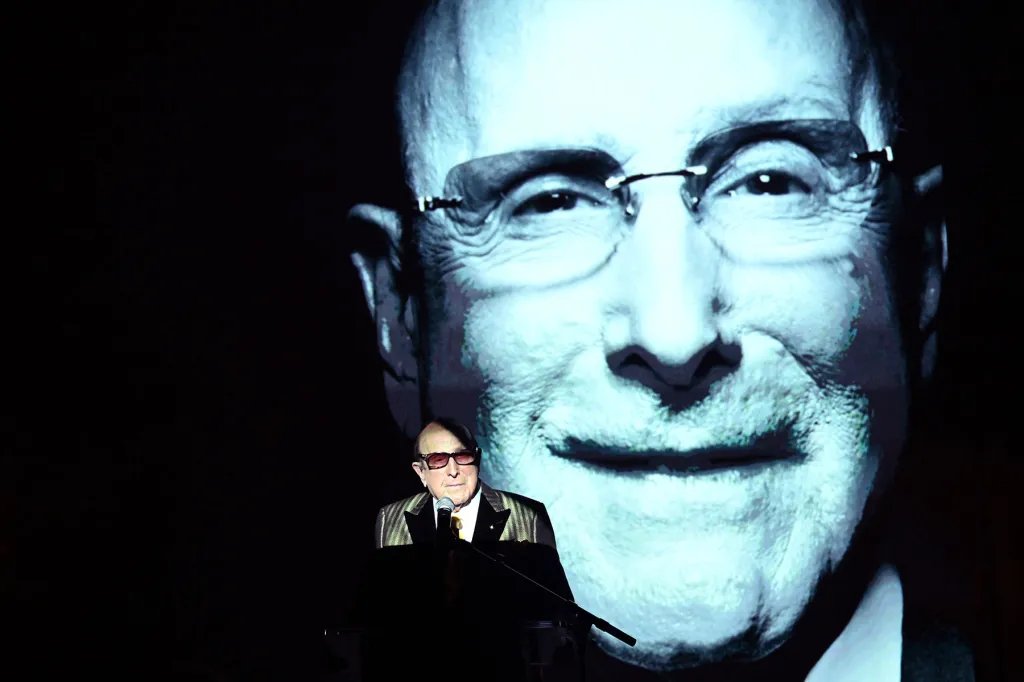

Clive Davis was a chart enthusiast even before he became a music industry legend. In his 1974 biography Clive: Inside the Record Business (which he co-wrote with James Willwerth), he explained his fascination with charts, which, he said, grew out of an earlier fascination with baseball statistics and Variety’s lists of top box-office hits.
“It was an extension of the star syndrome,” he wrote, “measuring how singers did against each other, watching their songs climb the Hit Parade. I was a reader of charts and statistics, and I found an excitement in them which is hard to explain, as if they represented a form of energy.” (Emphasis in the original.)
Since Davis was a chart fan to begin with, imagine what a kick it must have been for him to see his companies’ records ascend to the top spot on Billboard Hot 100, especially in the nearly four decades that he directly oversaw day-to-day operations at a succession of labels: CBS (Columbia and Epic), Arista and J Records.
According to Davis’ official bio, the exec was appointed vp and general manager of Columbia Records in 1966. In 1967, he was named president of the company. He oversaw Columbia and Epic and, in the early 1970s, signed a deal with Kenny Gamble & Leon Huff’s famed Philadelphia International Records, which had two No. 1 hits on the Hot 100 in 1972-73.
Davis was fired from CBS in May 1973 for reasons that have never been entirely clear, but which most certainly had nothing to do with his ability to do the job. Afterwards, he wasted no time in re-establishing his career: In January 1975, his Arista Records (named after his high school honors society) landed its first No. 1 Hot 100 hit with Barry Manilow’s “Mandy.” Again, Davis signed agreements that brought in more talent, especially in the burgeoning Black music area. He made an agreement with L.A. Reid and Babyface to form LaFace Records in October 1989. And in 1994, Davis and producer/entrepreneur Sean “Puffy” Combs (later known as Diddy) entered into a 50/50 joint venture that resulted in the creation of Bad Boy Records.
In 2000, Davis was forced out of Arista for age reasons (he was 68 at the time). But again, he wasted no time in re-establishing himself. That same year, he formed J Records (Jay was his middle name), which in August 2001 landed its first No. 1 Hot 100 hit with Alicia Keys’ “Fallin’.” (Both Manilow’s “Mandy” and “Fallin’” received Grammy nods for record of the year. In addition, “Fallin’” won song of the year.)
In November 2002, Davis became president/CEO of the RCA Music Group, assuming responsibility for RCA, Jive, Arista, LaFace and J. In April 2008, he was appointed chief creative officer of all of Sony Music Entertainment, which, as his official bio notes, represented “a change in operational responsibility but an expansion of the artists he would now creatively be responsible for.”
Our focus here is on the 36 years he was the top man at an individual label, not the later years when he oversaw entire label groups. He had 11 No. 1 hits by Whitney Houston in those years, more than any other artist. Elsewhere, he had four with TLC (on LaFace/Arista), and three each with Simon & Garfunkel, Sly & the Family Stone, Manilow, Billy Ocean (on Jive/Arista), Milli Vanilli and Puff Daddy (on Bad Boy/Arista).
Here’s a list of all the Hot 100 No. 1 hits at Davis-headed labels in those 36 years. The dates represent the date each single first reached No. 1, followed by the artist’s name and title of the record, the number of weeks the song held the top spot and the label.
Jan. 1, 1966: Simon & Garfunkel, “The Sounds of Silence,” (two weeks, Columbia)
Sept. 3, 1966: Donovan, “Sunshine Superman” (one week, Epic)
Oct. 21, 1967: Lulu, “To Sir With Love” (five weeks, Epic)
June 1, 1968: Simon & Garfunkel, “Mrs. Robinson” (three weeks, Columbia)
Feb. 15, 1969: Sly & the Family Stone, “Everyday People” (four weeks, Epic)
Feb. 14, 1970: Sly & the Family Stone, “Thank You (Falettin Me Be Mice Elf Agin)” (two weeks, Epic)
Feb. 28, 1970: Simon & Garfunkel, “Bridge Over Troubled Water” (six weeks, Columbia)
March 20, 1971: Janis Joplin, “Me and Bobby McGee” (two weeks, Columbia)
July 24, 1971: Raiders, “Indian Reservation (The Lament of the Cherokee Reservation Indian)” (one week, Columbia)
Dec. 4, 1971, Sly & the Family Stone, “Family Affair” (three weeks, Epic)
Aug. 26, 1972: Looking Glass, “Brandy (You’re a Fine Girl)” (one week, Epic)
Sept. 23, 1972: Mac Davis, “Baby Don’t Get Hooked on Me” (three weeks, Columbia)
Nov. 4, 1972: Johnny Nash, “I Can See Clearly Now” (four weeks, Epic)
Dec. 16, 1972: Billy Paul, “Me and Mrs. Jones” (three weeks, Philadelphia International)
March 24, 1973: The O’Jays, “Love Train” (one week, Philadelphia International)
May 26, 1973: The Edgar Winter Group, “Frankenstein” (one week, Epic)
Jan. 18, 1975: Barry Manilow, “Mandy” (one week, Arista)
Jan. 3, 1976: Barry Manilow, “I Write the Songs” (one week, Arista)
Jan. 17, 1976: The Bay City Rollers, “Saturday Night” (one week, Arista)
Sept. 23, 1977: Barry Manilow, “Looks Like We Made It” (one week, Arista)
July 25, 1981: Air Supply, “The One That You Love” (one week, Arista)
Aug. 11, 1984: Ray Parker Jr., “Ghostbusters” (three weeks, Arista)
Nov. 3, 1984: Billy Ocean, “Caribbean Queen (No More Love on the Run” (two weeks, Jive/Arista)
Oct. 26, 1985: Whitney Houston, “Saving All My Love for You” (one week, Arista)
Jan. 18, 1986: Dionne & Friends, “That’s What Friends Are For” (four weeks, Arista)
Feb. 15, 1986: Whitney Houston, “How Will I Know” (two weeks, Arista)
May 17, 1986: Whitney Houston: “Greatest Love of All” (three weeks, Arista)
July 5, 1986: Billy Ocean, “There’ll Be Sad Songs (To Make You Cry)” (one week, Jive/Arista)
April 18, 1987: Aretha Franklin & George Michael, “I Knew You Were Waiting (for Me)” (two weeks, Arista)
June 27, 1987: Whitney Houston, “I Wanna Dance With Somebody (Who Loves Me)” (two weeks, Arista)
Sept. 26, 1987: Whitney Houston, “Didn’t We Almost Have It All” (two weeks, Arista)
Jan. 9, 1988: Whitney Houston, “So Emotional” (one week, Arista)
Feb. 20, 1988: Expose, “Seasons Change” (one week, Arista)
April 9, 1988: Billy Ocean, “Get Outta My Dreams, Get Into My Car” (two weeks, Jive/Arista)
April 23, 1988: Whitney Houston, “Where Do Broken Hearts Go” (two weeks, Arista)
July 1, 1989: Milli Vanilli, “Baby Don’t Forget My Number” (one week, Arista)
Sept. 23, 1989: Milli Vanilli, “Girl I’m Gonna Miss You” (two weeks, Arista)
Nov. 25, 1989: Milli Vanilli, “Blame It on the Rain” (two weeks, Arista)
April 7, 1990: Taylor Dayne, “Love Will Lead Me Back” (one week, Arista)
Dec. 1, 1990: Whitney Houston, “I’m Your Baby Tonight” (one week, Arista)
Feb. 23, 1991: Whitney Houston, “All the Man That I Need” (two weeks, Arista)
Nov. 28, 1992: Whitney Houston, “I Will Always Love You” (14 weeks, Arista)
March 12, 1994: Ace of Base, “The Sign” (six weeks, Arista)
Jan. 28, 1995: TLC, “Creep” (four weeks, LaFace/Arista)
July 8, 1995: TLC, “Waterfalls” (seven weeks, LaFace/Arista)
Nov. 25, 1995: Whitney Houston, “Exhale (Shoop Shoop)” (one week, Arista)
July 27, 1996: Toni Braxton, “You’re Makin’ Me High” / “Let It Flow” (one week, LaFace/Arista)
Dec. 7, 1996: Toni Braxton, “Un-Break My Heart” (11 weeks, LaFace/Arista)
March 22, 1997: Puff Daddy (feat. Mase), “Can’t Nobody Hold Me Down” (six weeks, Bad Boy/Arista)
May 3, 1997: The Notorious B.I.G., “Hypnotize” (three weeks, Bad Boy/Arista)
June 14, 1997: Puff Daddy & Faith Evans (feat. 112), “I’ll Be Missing You” (11 weeks, Bad Boy/Arista)
Aug. 30, 1997: The Notorious B.I.G. (feat. Puff Daddy & Mase), “Mo Money Mo Problems” (two weeks, Bad Boy/Arista)
Feb. 14, 1998: Usher, “Nice & Slow” (two weeks, LaFace/Arista)
April 25, 1998: Next, “Too Close” (five weeks, Arista)
Oct. 3, 1998: Monica, “The First Night” (five weeks, Arista)
Feb. 13, 1999: Monica, “Angel of Mine” (four weeks, Arista)
April 10, 1999: TLC, “No Scrubs” (four weeks, LaFace/Arista)
Sept. 18, 1999: TLC, “Unpretty” (three weeks, LaFace/Arista)
Oct. 23, 1999: Santana feat. Rob Thomas, “Smooth” (12 weeks, Arista)
April 8, 2000: Santana feat. The Product G&B, “Maria Maria” (10 weeks, Arista)
Aug. 18, 2001: Alicia Keys, “Fallin’” (six weeks, J)