

The other day, RAYE was rewatching one of her old interviews. On screen, a much younger version of herself — dyed blonde hair in untamed coils, ambition sparkling in her eyes — spoke about her then-out-of-reach career dreams.
“My voice was a little bit squeakier,” the 28-year-old British pop powerhouse says now on a sunny March afternoon in Los Angeles, laughing fondly at her teenage tenacity. She mimics how she used to sound: “I’m like, ‘I just need a shot,’ ” she recalls. “I was so young and hungry.”
She’d eventually get that shot — but not for many excruciating years, and not in the way she’d once expected. It didn’t come in 2014, when she first signed with Polydor Records and felt, at the time, that she’d made it. Nor did it come in the years she spent under that contract, when other, more powerful people placed her lifelong goal of making an album on the eternal back burner. While her voice gravitated toward soulful pop, her label granted her only a few sparse EDM single releases, some of her own and some as a featured voice on other artists’ tracks — “In the U.K., dance music sold really well,” she explains — but primarily it worked her as a songwriter, her talents benefiting the careers of artists such as Beyoncé, Charli xcx and Ellie Goulding while her own remained in limbo.
By the time she posted an attention-grabbing series of tweets pleading for a change in 2021, she felt completely powerless. “I’m done being a polite pop star,” she wrote at the time. “I want to make my album now, please that is all I want.”
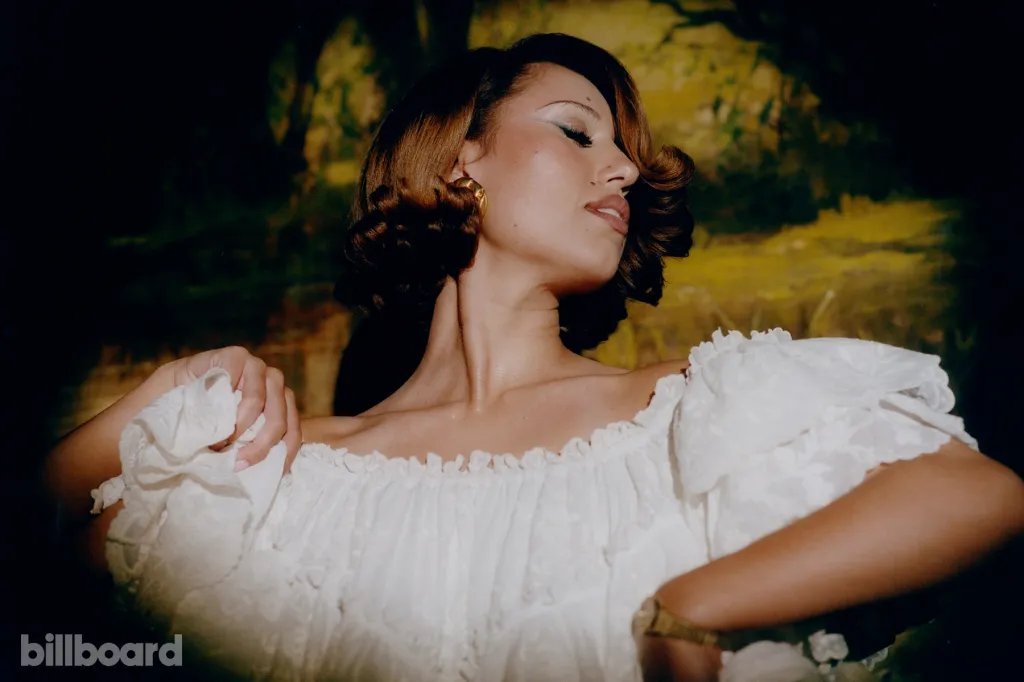
Today, things look a little different. For one, the blonde frizz is gone, in its place a chic brunette bob that — combined with RAYE’s angular face and bright red lips — makes her look a bit like a Jazz Age painting come to life. Anything but squeaky now, her speaking voice is just as divine as her otherworldly vocals, and she has colorful tattoos of the British, Swiss and Ghanaian flags stamped onto her forearm to remind her of her heritage. She’s hoping to get more ink soon, probably of a trumpet, to represent her maximalist, theatrical second album, This Music May Contain Hope, which is already one of the most talked-about pop releases of the year.
pmcCnx.cmd.push(function() {
pmcCnx({
settings: {
plugins: {
pmcAtlasMG: {
iabPlcmt: 2,
},
pmcCnx: {
singleAutoPlay: ‘auto’
}
}
},
playerId: «4057afa6-846b-4276-bc63-a9cf3a8aa1ed»,
mediaId: «5b8bdf10-9409-43a1-a1c4-966ca69f926c»,
}).render(«connatix_player_5b8bdf10-9409-43a1-a1c4-966ca69f926c_1»);
});
Because, yes: She did eventually get to make that album she’d always wanted — her critically acclaimed 2023 debut, My 21st Century Blues — and now this second one, too.
But before that, it was “seven years of a very tumultuous and complicated relationship with life and my purpose and what I was creating,” she says. “The person I am now is so different. I really like who I am now.”
She pauses. “I didn’t like who I was then.”
Dolce & Gabbana dress, Alice Skewis earrings.
Jingyu Lin
It’s clear that RAYE doesn’t enjoy looking back on that period, which is perhaps best summarized as “the before.” Ask her about making music, performing or even her top Nintendo games, and she lights up, making sweeping gestures with her arms and moving so much in her chair that it rocks as she talks. (It’s stupefying to hear her say modern phrases like “…Super Mario Galaxy 2, Donkey Kong — my favorite Switch game of all time is Super Mario Odyssey…” in a timbre that would make more sense drifting out of the most weathered vinyl in your grandmother’s collection.)
When discussing “the before,” though, she’s quieter. Her expression drops in a way that’s almost undetectable but leaves you wondering which unspoken memories are flashing through her mind. “I was not in a great place,” she says, keeping her replies general. “I was not around great people or doing great things.”
RAYE has been open in her music about having dealt with mental health, body image and drug dependency issues. She’s also alluded to feeling distant from her family during those years with Polydor, even though parents Paul and Sarah Keen now oversee her team, and she collaborates with her younger sisters, singer-songwriters Amma and Absolutely, who are currently opening on her This Tour May Contain New Music outing.
She’s been even less explicit about how her career and personal struggles have related to and fed one another. But on the Saturday of our conversation in the lounge of CenterStaging studios in Burbank, the temporary loading and rehearsal space for her band ahead of the spring North American leg of her trek, she acknowledges, “I think [it was] probably just an all-around combination. If you’re an artist creating stuff you resent or aren’t proud of … that whole time just wasn’t healthy, and some of it I don’t remember.”
“Those are the things that I hate to hear about RAYE’s past,” says Julius “J” Erving, whose company Human Re Sources distributed both of her albums, which she self-released. “I’m not speaking on any individual or company, but … you don’t want to see someone that you care about stressed, having anxiety or not doing well mentally.”
“I’d built some habits that were really destructive,” RAYE adds, noting that “drinking’s not ever been my vice” and she’s now sober from other substances. “Clearly, I was just unhappy. This industry isn’t for the faint of heart.”
She would know. Even as a songwriter for other artists, she faced repeated letdowns. An alum of the prestigious BRIT School performing arts academy who taught herself to use GarageBand as a preteen, RAYE was demoralized to learn upon entering the workforce how frequently people in power deployed “manipulation tactics” to lessen her pay splits or undercut her contributions to the music she helped write. (“Ask any songwriter,” she says grimly. “They know the deal.”) She’s since campaigned tirelessly for change, helping musician advocacy group The Ivors Academy secure a landmark deal between the government and major labels last year guaranteeing per diems and covered expenses for songwriters in the United Kingdom. But inequitable standards for royalty points and pushback on proper credits remain ongoing issues, which RAYE has now seen Amma and Absolutely face as they follow in her footsteps.
“People think just because you’re a ‘little girl’ that you aren’t entitled [to recognition],” she says, getting heated. “That because you added a couple synths and did the chords and the vocal production and this and that, well, you’re not a producer. It happened [to my sisters] over and over again” — she puffs up her chest, as if bracing for a fistfight — “and I was like, ‘Hold me back!’ ”
Schiaparelli dress and earrings.
Jingyu Lin
Through those hard years, the guidance of other women who could relate gave her strength. She still remembers feeling a new wind in her sails after Halsey praised her music offstage during the Hopeless Fountain Kingdom tour, which RAYE opened in 2018. And after feeling “so insecure” about the pressure to be in constant competition with other women in music, early collaborator Charli xcx “completely broke that narrative” by inviting her over — long before “brat summer” entered the pop cultural lexicon — and giving her tips to feel more confident onstage. “She was like, ‘OK, here’s your hairbrush,’ ” RAYE recalls, holding up an invisible pretend microphone. “‘Right, look in the mirror.’ ”
“Upon meeting [RAYE], I came to discover she was kind, funny, intelligent and determined,” Halsey tells Billboard. “It didn’t take long to find out she was also being obstructed. We talked a bit about our career journeys, and it was evident immediately that there was a destiny brewing inside her that was bursting to get free. She spoke about the hindrance at her label with an understandable amount of frustration and apathy, but without a single glimmer of surrender.”
“I’m just really grateful to all those girls,” RAYE says, adding in SZA and Taylor Swift, who also offered support when she served as their openers in 2023 and 2024, respectively. “That little time they took to pour into me really affirmed me and made me feel encouraged. Those things can make all the difference.”
Ultimately, after yet another instance where she was told one of her singles had to do well before she could start on an album — in this case, “Call on Me”; you can still find her old tweets asking fans to help her cause by streaming it — RAYE decided she couldn’t take it anymore. Hoping to force a rupture, she unleashed those posts exposing the pain of having her dreams kicked down the line for years, and 20 days later, on July 19, 2021, she returned to the internet with an announcement. “Today,” she wrote, “I am speaking to you as an independent artist.”
Polydor had agreed to release RAYE from her contract, allowing label and disgruntled signee to part ways relatively amicably — a rarity in the industry, and one for which she remains grateful, despite everything.
Finally, she was free to write, record and release whatever music she wanted, whenever she wanted. How did she feel about it?
“Absolutely terrified.”
When she first enters the studio where we meet in L.A., RAYE is trailed by an assistant holding a pair of heeled black boots that she repeatedly refuses to put on.
“Your stylist is going to kill me,” the assistant tells her, but she isn’t interested in wearing anything aside from her fuzzy slippers for our interview. Sometimes, she slips those off, too, living up to her reputation of going without shoes or socks, including onstage. (She is listed on Wikipedia’s page of notable “barefooters.”)
It’s a small, symbolic way in which RAYE is clearly calling her own shots. There are plenty of other signs, both subtle and direct; even before her arrival, her touring band was hard at work rehearsing live arrangements of the wildly ambitious songs she never could’ve dreamed of releasing a few years ago — and which she will perform not only on her headlining tour but also as an opener for Bruno Mars’ The Romantic stadium run, one of pop’s most coveted support slots this year. At various points, choreographer Maureen Moores reminds the string players to twirl their bows in the air like lassos every time RAYE sings “Holla!” during lead single “Where Is My Husband!,” which reached No. 11 on the Billboard Hot 100 in April, her highest peak on the chart to date. Just a few days ago, she performed the song as Swift, among other major stars, let loose in the audience at the iHeartRadio Music Awards. And as we’re wrapping up for the day, she smiles mischievously while recounting how good it felt to “scream” her smash hit at people from “the old label” who had been in attendance.
Welcome to “the after.” It’s RAYE’s show now.
Gucci faux fur coat, earrings and heels.
Jingyu Lin
Over the past several years, more and more artists have found success independently — but few have achieved the kind of growth from start to finish that RAYE has without a label. Since leaving Polydor, she’s racked up billions of streams, notched two U.K. No. 1 singles and won seven BRIT Awards (six of which were in 2024, a record for the most in one year). Erving thinks she’s on track to become the world’s first independent global superstar.
How did she get here? Even she isn’t sure, to be honest. “I don’t even know what we were doing,” she says, the past half-decade a blur. “It was a lot of hustling.”
That included “no sleep, stupid travel hours” and “belting into any microphone” she was given, plus lots of self-funding and trading favors — like when she played a free gig for a friend in exchange for use of his club as a music video set. “I don’t know how many music videos we shot in my house,” she reminisces. “Bags on the windows, rent lighting … I remember getting [“Escapism.” collaborator] 070 Shake in my living room and shooting her part [with] this weird circle light.”
The only thing RAYE was absolutely certain of when it came to launching her indie journey was the very first step she was going to take: make an album. Overwhelmed by relief, exhaustion, excitement and fear, one question guided her as she embarked on the process of curating the track list, assembling instrumentalists and dictating studio time herself: “What album would I want to make if no one was telling me what album to make?”
The result was My 21st Century Blues, a rich “gumbo” — as Erving likes to think of it — of potent jazz, soul, gospel, pop and R&B flavors, across songs both old (previously forced to stay shelved) and new. After years of releasing hardly anything, it seemed as if she’d packed as much sound as humanly possible into the set — a daunting task assisted by producer Mike Sabath, who returned for several tracks on the somehow even more grandiose This Music May Contain Hope.
One thing she couldn’t do on her own was get her album on shelves. Fortunately, she didn’t need to worry about navigating the search for a business partner by herself; she’d found her perfect manager long before leaving Polydor.
Born in 1997 in South London, RAYE was 10 when she first told her father on the playground that she was going to be an artist. (Later, after workshopping her stage moniker with her family, she went to her secondary-school teachers and requested that they no longer call her by her birth name, Rachel Keen.) About a decade and a half after that moment, roughly 2019 or 2020, Paul Keen — formerly a business analyst — stepped in to represent his eldest daughter, at her request, after she split from her first manager. The arrangement was supposed to be temporary, she says, but then “he started doing such a great job.”
“It was impostor syndrome for a minute, and then a fast learning process,” says Keen, who, unlike RAYE, is soft-spoken and sits completely still while we talk. After observing the industry from the passenger seat as a father with kids pursuing careers as artists, he already had a wealth of knowledge when applying his own business acumen to music. “As a manager … you’re there to advise, you’re there to support, to catch them if they fall. That’s a parent anyway. It’s pretty much the same.”
Of their partnership, RAYE says tenderly, “Going through so much as a young girl in this industry in terms of being unprotected … I was quite traumatized. So I think as soon as my dad started working with me, I just immediately felt safe.”
She’s referring, at least in large part, to her experiences with sexual abuse — trauma she kept hidden from her family for years. Her parents only found out around 2019 when they first heard “Ice Cream Man.,” a song she wrote about a producer who assaulted her and later released on her debut. Afterward, she says the three of them “just spent a day crying.”
Upon hearing the song, Keen remembers thinking: “I can’t even process this.” He still doesn’t know the specifics of what happened to his daughter. Even with him, she prefers to speak through music.
RAYE now strongly doubts she’ll ever sign with a traditional label again — and at this point, why would she need to? But when she was ready to release My 21st Century Blues, she was open to any agreement. “It was so humbling,” she says of going “around to anyone who would take a meeting” with her. “Some people were like, ‘We love RAYE, but this album, we can’t support it.’ Half were like, ‘We’d be down to sign you, but not with this album.’
“Labels said no,” she continues. “Distribution companies said no. Everyone said no.”
Except for one. J Erving, three years into running Human Re Sources, knew he wanted to offer RAYE a distribution deal before he even finished listening to the album’s first song (“Oscar Winning Tears.”). He says, “I just felt very lucky that other people hadn’t heard it the same way I did.”
Chloe dress, belt and earrings, Audemars Piguet watch.
Jingyu Lin
It wasn’t that he was the only person who thought the album had commercial potential — he just didn’t particularly care if it did.
“I’m all old,” he quips dryly, noting he trusts “the hair on the back of my neck and the goose bumps on my arm” over, for instance, whether a song is doing well on TikTok. “RAYE has music that’s going to move culture. That, to me, is what it’s about — not trying to count dollars and cents.”
In June 2022, Erving signed her to an exclusive licensing agreement with Human Re Sources — distributed globally by The Orchard — allowing her total agency as an independent artist with full ownership of her masters. They released a handful of singles together before “Escapism.” became the first to really take off. A deeply personal song about how RAYE numbed herself emotionally during her darker moments, the song peaked at No. 22 on the Hot 100 — the type of pop crossover that has become increasingly rare for indie artists — and with its success, RAYE knew that the shot she’d been waiting for had come. When the track reached No. 1 in the United Kingdom (it later propelled My 21st Century Blues to No. 2 on the albums chart), she posted a video of herself crumpled on the floor with her plaque in hand, sobbing.
It’s a moving story. But while it’s tempting to view her arc as aspirational — and parts of it certainly are — RAYE knows that she’s still one of the exceptionally lucky.
When asked what advice she’d give to aspiring musicians questioning whether they should sign with a major label, she overflows with words of hard-earned wisdom: Build your own audience first so that you have leverage from the jump, make sure you understand that every penny your label “spends” on you comes out of your earnings later on, etc. But to artists stuck in the situation she was in, bound unhappily to a contract and perhaps searching for a light at the end of the tunnel, she falters.
“I honestly don’t know,” she says after a moment, stumped. “Maybe, I don’t know, try to have a conversation with your label…?”
She trails off, knowing better.
Every parent sees their little kid in the nativity play, and you’re not looking at anyone else — just your own kid,” Paul Keen marvels. “To see her play the likes of where we are today, it’s mind-blowing. You never get used to it.”
We’re backstage at Radio City Music Hall, RAYE’s dream venue that she’s sold out for the next two nights. It’s been three weeks since our conversation on the opposite coast, where she’d described her setup as a “little family business” — a concept that’s now on full display as Amma’s voice sparkles over the dressing-room speakers during sound check, and mom Sarah Keen makes her rounds to ensure that not just her children, but also the band and crew, are well looked after. She was previously a National Health Service mental health specialist, but now, she’s like a “professional mom” for the whole team, as Paul explains.
He thinks RAYE portrayed an angel in their church Christmas pageant — but it’s been a long time, and he’s not quite sure. Regardless, she embodies the role beautifully onstage in an elegant, Old Hollywood-esque red dress hours later, arms raised above her head like wings as she commands her 21-piece band, glowing beneath the spotlight. It’s spectacular to witness the way music moves through her body, radiating outward like beams of light as she fills the theater with her invincible battle cry.
“I expect her to be Céline Dion level in her career,” SZA tells Billboard of her former tourmate. “It’s unbelievable: her writing, her voice, her melody choice, her commitment to intricacy and true artistry. I’m just a fan. I hope that we can work together at some point.”
When she’s not performing, RAYE maintains strict vocal rest to preserve her chops night after night, having “pushed [her] body to the limit” on the European leg of her tour while simultaneously finishing This Music May Contain Hope earlier this year. “If I wasn’t onstage, I was in the studio working on it,” she says, noting she turned in the album just one week before its release. “It was a lot. I feel like the songs are just getting bigger and bigger.”
Balenciaga dress and heels.
Jingyu Lin
That’s an understatement. On album and show opener “I Will Overcome.,” RAYE switches from rap to opera to full-throated belting over a thunderous action sequence of timpani, trumpets and strings, lyrically encouraging herself to persevere over critics internal and external. The most poignant line calls out one popular double-edged comparison people have been making since she found fame: “Some people say I remind them of Amy [Winehouse]/Some spit through their keyboards, I’ll never amount,” she croons, emerging onstage in a fur coat and sunglasses. “And the evil in insults, the arrows from your tongue/[Are] the same devils you tortured her with.”
Of choosing to address this so frankly, RAYE says, “Amy went through being berated and annihilated through words — by the press, by the public, by everyone. I just wanted to say that, because … I get a lot of beautiful, lovely, kind things.
“Unfortunately,” she adds, “The negative things are just louder.”
Erving says that this is “probably the thing that concerns me the most” about his star client. “She’s taking so much on herself,” he explains. “A lot of my conversations with RAYE are, ‘Get your rest. Don’t put pressure on yourself. Don’t get caught up in the one comment on your socials that’s not positive.’ ”
He and RAYE often hang out backstage on nights like tonight, but they hardly ever talk business. That’s mainly because she’s so self-sufficient; the most Erving is ever involved in her creative decisions is that she’ll maybe FaceTime him from the studio every once in a while just to give him an update on what she’s doing. “What I recognized very quickly was: Get out of her way,” he says.
Instead, the two will chat about their shared faith and personal lives when they’re together, or get a little too competitive over card games. (“We both come to win,” he says, dead serious.) They were supposed to try out a new one, Sequence, at Radio City, but didn’t get around to it. “She owes me,” Erving texts me later.
To stay grounded, RAYE’s recently taken up journaling and hiking, even though she “used to hate” the latter. She’s hoping to go fishing at some point on this stretch of tour before it wraps with two hometown shows at the O2 Arena in London in mid-May. But nothing is more cathartic for her than performing. In New York, she asserts her belief that “music is medicine” numerous times onstage, allowing herself to momentarily relive her past while singing “Ice Cream Man.” at the piano, the crowd watching her heal in real time.
If she ever felt muzzled before, that’s long over now. She tells the audience that sexual assault and rape are “words I’ve decided to stop apologizing for saying out loud” and adds, teary-eyed, “An evil person should not be able … to come into my life and [tell] me, ‘You’re now going to be half of yourself.’ I rebuke that.”
With nothing left to prove after My 21st Century Blues, RAYE says that creating her second album “felt free” — an act of love rather than survival. “It was me versus myself,” she says. “I didn’t compromise on anything.” Another prevalent message on the album is the importance of mental health awareness, partially inspired by conversations with men in her life and the United Kingdom’s devastating male suicide rates. In 2025, she watched Chappell Roan accept best new artist at the Grammy Awards — for which she was also nominated — and urge labels to take better care of artists’ well-being. After what she’d been through, it hit close to home for RAYE.
“I really wanted to create music … that can provide space for those emotions to force their way to the surface and be addressed,” she says. “What Chappell said there was very important, and I think on a large scale — not just in music, but in all walks of life — we need to figure out ways to create spaces for mental health and these conversations to be more normal. Or for you to not have to hit rock bottom in order for you to be like, ‘Maybe I need some help.’ ”
On songs like “Where Is My Husband!,” where she literally searches for the future Mr. RAYE, or “Nightingale Lane.,” a haunting look at how heartbreak is simply a painful reminder she’s capable of love, she also boldly lets her guard down in the unabashed pursuit of romance. Of dating now, she says with a laugh, “It’s been genuinely so many years that it feels alien to me.
“Sometimes I’m very assured and confident and happy with my life, and then some days I’m watching a rom-com, and I’m like, ‘Where? Where?’ ” she continues. “But it’s not serious. I’m not crying myself to sleep every night — just some nights.”
But what the album mainly deals in, as its title suggests, is hope. On standout track “Life Boat.,” RAYE and her loved ones repeat the powerful phrase, “I’m not giving up yet.” She is living proof of what can happen when you stick to that mantra. In June, she’ll accept the Hal David Starlight Award at this year’s Songwriters Hall of Fame induction, and from August to January, she’ll play stadiums supporting Mars. After that, who knows?
One thing you’ll never see her do, though, is rest on her laurels. At one point in her concert, she encourages fans to get out their phone cameras before unveiling a sign with a QR code linking to her album’s sales page — because the hustling doesn’t stop, even now.
“We might have sold out Radio City,” she says with a wink. “But I am still an independent artist!”
This story appears in the May 9, 2026, issue of Billboard.