

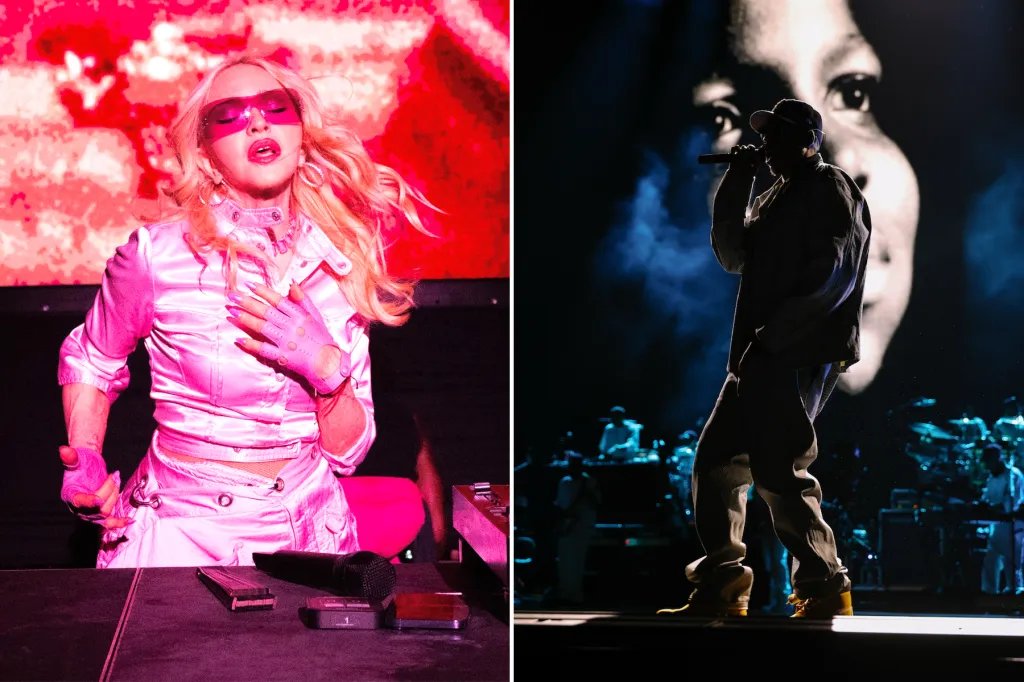

When Madonna shared an unassuming Club Confessions poster to her Instagram Story early last week (July 8), I knew I was in for what would undoubtedly be a once-in-a-lifetime NYC weekend. Because I wouldn’t just be experiencing Madge and superproducer Stuart Price bringing Confessions II to life at Knockdown Center on the border of Queens and Brooklyn, the following night, just a borough away in the Bronx, I’d also bear witness to the highly anticipated finale of Jay-Z’s historic, three-night Yankee Stadium residency.
As an early Gen Z Flatbush boy, I was practically born into Hov’s legion of Brooklyn-bred die-hards; growing up, I’d look up from whatever fantasy novel I’d be lost in, only to be met with a portrait of Shawn Carter staring back at me in the Brooklyn Public Library’s central branch. The summer I got my first three-month Spotify prescription, Madonna was one of the artists I plunged into a deep dive of, nearly instantly activating what had to be a dormant allegiance to the undisputed Queen of Pop. Though both Madonna, 67, and Jay-Z, 56, are more than double my age, they’re two of my favorite artists of all time — and I promise, dear reader, both of them being New York icons has nothing to do with it!
I simply couldn’t help but feel that I would learn something very special from the one-two punch of Club Confessions and Extra Innings. My hunch was that my lesson would have something to do with community. But part of me also hoped that I’d be able to see if two of NYC’s greatest musical mythologies still hold up — and figure out how my peers and I could harness the city’s magic for the next few decades, just as they did.
Alongside two dear, homegrown friends, I entered Club Confessions through Madonna’s legs — a fitting gateway considering the “It’s mutha! It’s mutha!” chants that would announce the beginning of her set. But that wouldn’t be for another few hours, and after slyly maneuvering through a blocks-long line that brought a kaleidoscope of queerness to Maspeth, Queens, it was time to enter Madge’s hot pink fantasia. Once we made our way through a corridor straight out of the “Good for the Soul” visual, we were handed several drink tickets by a smoldering, latex-adorned doll, good for all things Absolut Vodka, which sponsored the event in partnership with free PrEP medication provider Mistr. Sectioned off from the main dance floor was the Absolut Icon Room, complete with specialty cocktails inspired by the Queen of Pop, like the citrus-forward Absolut Madonna and the much-needed Absolut Ex-Presso Yourself Martini. After all, what’s pop music without a little commercialism? (And what’s an invite-only, NYC press event without a flashy brand partnership?)
The push-and-pull of idealistic dancefloor escapism and capitalistic exclusivity certainly colored the night, which made it all the more moving to experience how “One Step Away” — Madonna herself proclaimed it to have “the best f—king bassline ever!” — pushed the room closer to nirvana in spite of that baked-in contradiction. Openers Junior Sanchez and Fcukers expertly primed the dancefloor with bone-rattling rhythms that soundtracked surprise reunions — this was still an industry-heavy gathering! — and one-night-only connections with so much verve that it felt like no time had passed between our entry and Madonna’s instantly iconic emergence at 1:10 a.m. ET.
First, I saw what looked like a zipped-up tracksuit. Assuming it was indeed Price, I quickly whipped out my phone, mentally thanking Apple for its 15x zoom capabilities — but also silently apologizing to Madge, who’s previously expressed her distaste for audiences prioritizing recording during live shows. (Surely, she would understand.) It wasn’t just Mother who came down to Earth on Saturday night; it was also the grand return of the OG “L.E.S. Girl” to the city where she rebirthed herself nearly 50 years ago. Talk about “transplants” who did it right! If Knockdown Center were an opera house, the phones attached to the longest arms on the dance floor were communal binoculars – and Madonna was the starring diva.
Staying true to her career-long commitment to focusing on new material over nostalgia plays – save for, say, 2023’s hits-foregrounding Celebration Tour — Madonna positioned Confessions II, her outstanding sequel to 2005’s Confessions on a Dance Floor and her first LP of the 2020s, as the centerpiece for her Price- and Honey Dijon-assisted set. “New York, I love you so much – but are you ready?!” she asked over the warbling, hypnotic synths of “One Step Away,” a fitting introduction for a set that would transport the room into an immersive strut down Madonna’s most intimate, myth-making memories of ’80s NYC. The set reached its apex with the triple whammy of “School,” “Bring Your Love” and “Danceteria,” turning the place into an all-out rave. Let me just say this: I doubt many experiences in my life will stack up to witnessing a 2026-era Madonna climb atop a DJ booth to proclaim, “School is in session” over a generation-spanning collection of queer folk who promptly lost their collective minds.
And Saturday night truly did feel like an Ivy League-level lesson in both pop superstardom and the power of dance music. Watching Madonna perform her Sabrina Carpenter-assisted “Bring Your Love” without the pint-sized Gen Z pop princess was a reminder that the dancefloor has no age limit — something that should be yelled from the rooftops as much as possible to combat the worst inclinations of our youth-obsessed culture. But it was the literal history lesson during “Danceteria” — which absolutely rocked the venue — that proved the night’s most poignant moment.
Something spiritual happened as Madonna’s voice rang out across the club, referencing close personal friends and NYC art and club scene architects like Haoui Montaug, Debi Mazar, Mark Kamins and Tony Shafrazi. In my quarter-century of New York residence, I’ve witnessed gentrification completely transform my beloved neighborhood of Flatbush and the larger, still-unmatched borough of Brooklyn. That same ill, which has only intensified its insidiousness in the wake of variety-flattening TikTok “recommendations” and the proliferation of young transplants who extract and exploit more than they positively contribute, has rewritten the look and feel of the Lower East Side over the past four decades. And Madonna’s urgent, yet unmistakably mournful, insistence that “every one of you is a work of art” — and, perhaps more importantly, that we all “get up and dance” — landed as a baby boomer’s last-ditch attempt to activate the spark of bygone dance eras, for a generation who probably needs it more than anyone who came before them.
In an era streaked by people who’ve barely entered their 20s surrendering to the calculated trap of social media-induced beauty standards — by whacking their faces with hammers or throwing away hundreds of dollars on questionable peptides, steroids, supplements and serums — a new center of gravity emerges when a 67-year-old proclaims that we’re all works of art. Sure, Madge was still decked out in wavy blonde hair, silver thigh-boots, and a hot-pink jacket, but her slightly labored hobble atop the DJ booth told the full story. She may not be able to move like she used to, but that doesn’t mean the music still can’t move her — and us — through space and time.
I’ve watched digital romance, on-demand sex apps, and, of course, the COVID-19 pandemic completely reconfigure my generation’s relationship with our bodies, going out, and being perceived while in public. It’s not an exaggeration when some say that genuine community and connection feel harder than ever to come by, if not impossible, and that’s part of why Club Confessions resonated with me so deeply. Did most of the mostly white, 40+ clientele feel straight out of The Eagle? Yes. Was the night still a legendary ode to dance music, localizing its powers in 40 years of New York City history and contextualizing its unifying tendencies through Madonna’s intergenerational repertoire? Also yes.
Just as Madonna cradled Confessions II with older catalog cuts that charted her dance-pop evolution — like 1983’s “Physical Attraction” and the original Confessions’ “Get Together” — Jay-Z anchored his three-night, 30-year career celebration at Yankee Stadium with a setlist that bolstered the myth he’s spent his life crafting and maintaining. Jay’s my hometown hero, but I’ve grown up with the version of him who had transcended his drug-dealing days and reached billionaire status, reshaping music, fashion, sports and business with a steadfast commitment to the ideals of Black excellence and upward mobility.
And the Hov controversies I grew up with had nothing to do with, say, Lance “Un” Rivera. They had more to do with the NFL and Colin Kaepernick, the Nets moving from Jersey to Brooklyn and the construction of Barclays Center. As someone who names In My Lifetime, Vol.1, 4:44, and, of course, Reasonable Doubt as some of his favorite albums of all time, I had been looking forward to Extra Innings since the shows were first announced in March. But I had to survive a four-hour delay first.
On Sunday at around 1:00 p.m. ET, about seven hours before the posted Night Three show time, Yankee Stadium’s official accounts shared graphics encouraging fans to arrive early. In typical New York fashion, I had a busy weekend schedule — and I was still recovering from Club Confessions — so I arrived shortly before 7:00 p.m. ET. Greeted with hordes of beautiful, grown Black folk decked out in Jay-Z merch and the unofficial NYC uniform (Yankee fitted, white tee, blue denim jeans/jorts and a pair of Butters/AF1s), there were virtually no instructions for which gates to enter. After getting in line for Gate 4 and waiting there for 20-30 minutes, a group of fans (some of whom did not have tickets) successfully overpowered the admittedly understaffed security, breaching the stadium and leading to the closure of that entrance. I walked over to Gate 8, only for a similar situation to happen, and by the time I made it to the entrance for suite tickets, the NYPD put Yankee Stadium on a total lockdown.
With tens of thousands of fans anxiously waiting outside, Jay-Z reportedly refused to begin the show until everyone who bought a ticket was able to enter the venue. Intense arguments threatened to turn into fisticuffs; I watched Knicks legend Charles Oakley and his Real Housewives of Atlanta-starring wife Angela narrowly avoid getting trampled when a gap opened in one of the barricades, and one fan encouraged other ticketholders to capture evidence for an eventual class action lawsuit. People were passing out due to a lack of water or access to bathrooms, and medics were called to multiple sites. It was one of the ugliest concert scenes I’d ever witnessed.
I love performing and watching live shows, so I live for the stage. But I’m also part of a generation that has an increasingly complicated relationship with concerts. Every generation has its defining, great American tragedy, and many would argue that for elder Gen Z, it’s the Sandy Hook school shooting. Back in high school, I was always good for an appearance at a March for Our Lives rally; gun violence and the threat of mass shootings colored every waking moment of my adolescence.
But I also remember where I was when 22 concertgoers lost their lives in a Manchester Arena bombing during Ariana Grande’s 2017 Dangerous Woman Tour. I remember sprinting through Central Park after the echo of a fallen barricade sounded like a gunshot during the 2021 Global Citizen Festival. I’ll never forget watching a real-time livestream of Travis Scott’s 2021 Astroworld Festival, where a crowd crush killed 10 people. I experienced several moments of real fear outside of Yankee Stadium on Sunday night, but after nearly four hours and a glacial security line, I made it to the field just before Mr. Carter hit the stage a little after 12:30 a.m. ET, ready to witness hip-hop history.
With Friday night’s show celebrating 30 years of Reasonable Doubt and Saturday night’s show feting the 25th anniversary of The Blueprint, Jay opted for a career-spanning set for Extra Innings — one that notably shied away from much of his 2010s material. “I got some s—t for y’all,” he promised after addressing the lengthy delay — and, man, did he. Teyana Taylor battled in-ear issues for “Can’t Knock the Hustle”; Usher popped out for an inexplicably seductive version of “Heart of the City (Ain’t No Love)”; Clipse rolled through for “Grindin’”; Jeezy brought grown men to tears with “Seen It All”; Jermaine Dupri delivered on “Money Ain’t a Thang”; Swizz Beatz put on for The Bronx and The-Dream came out for “No Church in the Wild.” And while the jaw-dropping rotation of surprise guests (what other concert can say they got both Beyoncé and Rihanna?) did its part to make up for the delay — when the King calls, seemingly everyone answers — they still felt like little more than an accessory to the night’s main attraction. Because Extra Innings was all about the narrative.
On Friday, JAŸ re-established the gritty, hustler’s ambition ethos that grounded his legendary ascent, and on Saturday, “Brooklyn’s Finest” delivered a stadium-rocking victory lap that celebrated just how far that ethos could take him. On Sunday, he made it his mission to remind everyone that NYC’s persistence-minded mythos is still worth buying into — even if the veil has been lifted on the tales of upward socioeconomic mobility that comprise so much of his approach to hip-hop and celebrity.
After beginning with “Intro (The Dynasty)” and a brief Biggie tribute, Jay launched into In My Lifetime’s evocative “Where I’m From,” which he blended with 4:44’s “Marcy Me” to deliver a decades-spanning look at the evolution of Kings County between his second and most recent studio albums. Though that evolution can often feel like the erosion of a rawer, realer Brooklyn (“I’m from where the hammers rung, news cameras never come”), the inclusion of “Marcy Me” momentarily reframes it as an elevation — or at least the persistent potential to build something greater than the cards dealt to you. Yes, the city has changed (as any barbershop conversation will remind you), but despite that, “We know who we are/ Yet we know not what we may be,” as Hov spits, interpolating a line from Hamlet; look where that NYC ambition took Jay — who’s to say it still can’t take tomorrow’s born-and-bred titans to even more staggering heights?
By the time Hov reached Reasonable Doubt’s “Can I Live” — an eternal ode to a very specific, NYC-honed work ethic — I couldn’t help but think about that song’s refrain in relation to the somewhat exasperated freestyle he spit during Friday night’s show. “You shopping at Amazon or you boycott/ You posting on Instagram? That’s Meta, boy, stop it/ You know Google owns YouTube, you picking and choosing/ The Politickin’ as usual,” he spit, seemingly attempting to call out what he perceives as the hypocrisy of his working-class critics’ attempts at boycotting in the age of late-stage capitalism. It almost felt like that was who he was directing his “Can I live?” inquiry to — but as much as Jay invites us to gawk at, praise and buy into his mythology, that’s also an invitation for us to put it under a microscope. Especially when the work ethic we’re applauding is being spent on upholding the ruse of “Black faces in high places.”
There’s a part of Hov that still wants everybody to buy into his mythology without poking holes in it — and ain’t that the most New York n—a s—t. It’s possible, and even preferable, for him to simultaneously be a street rap legend and business icon, but that duality isn’t worth noting if we can’t take an honest look at how that evolution happened. Because not only is that duality reminiscent of the highly stratified nature of present-day NYC, but it’s also through that duality that we can source new ways to wield the city’s hustler’s mindset as a tool for collective liberation over individual advancement at the expense of community wellbeing.
And that’s the point Jay’s Jadakiss- and Fat Joe-assisted “New York” finale medley drove home: the city’s magic lives on — and it’s the next generation’s turn to flip into a vision of their own. As Sinatra’s “Theme for New York, New York” transitioned into “Empire State of Mind” and later “New York,” the Extra Innings finale proved a fitting bookend to my weekend. And it wasn’t lost on me that all three of those songs soundtracked the Knicks’ championship, which, in turn, felt like the official kickoff for a particularly legendary NYC summer. 2016 may have finally gotten its true successor.
Both Madonna and Jay represent two different and equally vital New York City worlds, energies and mythologies — and they both turned moments of career triumph and celebration into history lessons that harnessed the city’s past to better position it for a future that maintains the uniqueness of its emotional fabric. Between the Knicks’ championship and Mayor Zohran Mamdani’s ongoing, paradigm-shifting term, I’ve never felt prouder to call New York City my home — and I’ve never felt more grateful to live in a city where I can pick up nuggets of wisdom from music superstars like they’re my own personal elders.
This past weekend was a historic addition to centuries of NYC storytelling, and it will almost undoubtedly serve as a notable catalyst and artistic reboot for the city’s burgeoning culture-shifters. Not that they weren’t already doing their thing, but there’s nothing like getting a battery in your pack from watching the Queen of Pop and King of Rap relive their respective era-defining memories across back-to-back nights. As Jay raps in “Where I’m From,” this “summer’s unforgettable.”